
Introduction
In today’s digital-first business environment, data is one of the most valuable assets organizations possess. Every customer interaction, sales transaction, marketing campaign, operational process, and connected device generates data that can provide valuable business insights. However, collecting data alone is not enough. Organizations must be able to transform raw information into actionable insights that support informed and timely decision-making.
This is where Business Intelligence (BI) plays a critical role.
Business Intelligence solutions enable organizations to collect, analyze, visualize, and interpret data from multiple sources. Through dashboards, reports, analytics, and performance monitoring tools, businesses gain visibility into operations, customer behavior, financial performance, and market trends.
As organizations continue to embrace digital transformation, investments in Business Intelligence tools are growing across industries. Businesses are increasingly leveraging BI platforms to improve operational efficiency, optimize resources, enhance customer experiences, and support data-driven decision-making.
Despite these benefits, many BI initiatives fail to deliver the expected outcomes. Organizations often invest in sophisticated reporting tools but struggle with poor data quality, disconnected systems, low user adoption, governance challenges, and scalability concerns. In many cases, technology is not the problem—the implementation strategy is.
Successful Business Intelligence implementation requires more than deploying dashboards and reports. It involves aligning technology, processes, data, and people around clearly defined business objectives.
According to industry research, poor data quality costs organizations millions annually through inefficiencies, reporting errors, and missed business opportunities. In this guide, we’ll explore the most common Business Intelligence implementation challenges, examine why BI projects often struggle, and discuss proven best practices that help organizations maximize the value of their BI investments
What Is Business Intelligence Implementation?
Business Intelligence implementation is the process of planning, deploying, integrating, and adopting BI solutions that enable organizations to transform business data into meaningful insights. The objective is to provide accurate, timely, and actionable information that supports both strategic and operational decision-making.
A successful BI implementation typically includes the following components:
- Data Collection: Gathering information from multiple business systems such as ERP platforms, CRM applications, finance systems, marketing platforms, operational databases, and third-party sources.
- Data Integration: Combining information from multiple systems into a centralized environment that ensures consistency and accessibility across the organization.
- Data Transformation: Cleaning, validating, standardizing, and organizing data to improve quality and reporting accuracy.
- Dashboard Development: Create interactive Business Intelligence dashboards that provide visibility into key performance indicators (KPIs) and business metrics.
- Reporting Solutions: Developing automated reports that deliver real-time and historical insights to stakeholders.
- User Adoption: Ensuring employees understand how to use BI tools effectively and incorporate data into daily business decisions. When implemented correctly, Business Intelligence helps organizations improve visibility, accelerate decision-making, reduce operational inefficiencies, and uncover new growth opportunities.
Why Business Intelligence Projects Often Struggle
Many organizations view BI initiatives primarily as technology projects rather than business transformation initiatives. As a result, significant effort is often invested in selecting software platforms and designing dashboards without first establishing business objectives, governance frameworks, or user adoption strategies. This approach can create reporting systems that generate information but fail to influence business decisions.
Common reasons BI projects struggle include:
- Poor data quality
- Data integration challenges
- Lack of executive sponsorship
- Undefined business goals
- Weak governance practices
- Low user adoption
- Scalability limitations
- Insufficient performance monitoring
Before implementing solutions, organizations must understand the challenges that commonly derail BI initiatives.
Business Intelligence Implementation Lifecycle
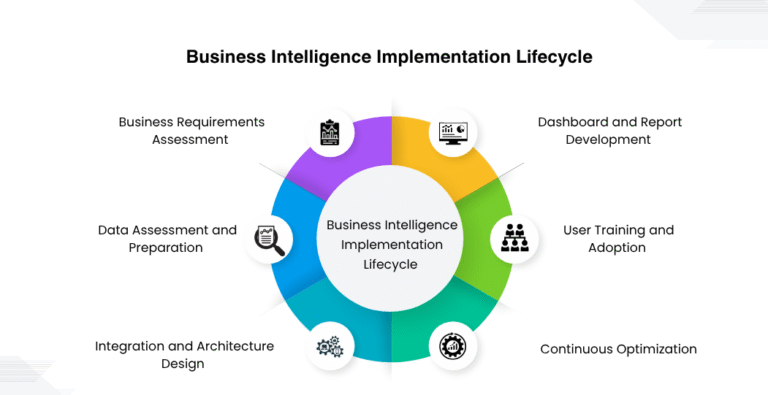
One of the most overlooked aspects of BI success is following a structured implementation lifecycle. similar to a well-defined Business Process Management lifecycle. Organizations that skip critical planning and governance stages often experience delays, poor adoption, and disappointing outcomes.
A successful BI implementation generally follows six key phases.
Phase 1: Business Requirements Assessment
The first step is understanding the business problems that need to be solved.
Organizations should identify:
- Key business objectives
- Critical performance indicators
- Reporting requirements
- Stakeholder expectations
- Success metrics
Starting with business goals ensures that the BI initiative delivers measurable value.
Phase 2: Data Assessment and Preparation
Before building dashboards, organizations must evaluate the quality and availability of existing data.
This phase includes:
- Data source identification
- Data quality assessment
- Data cleansing
- Data mapping
- Governance planning
Strong data foundations are essential for accurate reporting.
Phase 3: Integration and Architecture Design
At this stage, organizations define how data will move across systems.
Activities include:
- Data warehouse design
- API integration planning
- Security framework development
- Infrastructure selection
- Scalability planning
A well-designed architecture prevents future performance and integration issues.
Phase 4: Dashboard and Report Development
Once data pipelines are established, BI teams begin creating dashboards and reports.
Best practices include:
- Role-based dashboards
- KPI-focused reporting
- Intuitive visualization design
- Self-service analytics capabilities
The goal is to make insights accessible and actionable.
Phase 5: User Training and Adoption
Technology adoption is often the determining factor in BI success.
Organizations should provide:
- Role-based training
- User documentation
- Executive sponsorship
- Change management support
- Continuous education programs
Employees who understand the value of BI are more likely to embrace data-driven decision-making.
Phase 6: Continuous Optimization
Business Intelligence is not a one-time project.
Organizations should continuously monitor:
- Dashboard usage
- Reporting accuracy
- KPI achievement
- User engagement
- Business outcomes
Continuous optimization helps maximize ROI and ensures the BI environment evolves alongside business needs.
Top Business Intelligence Implementation Challenges
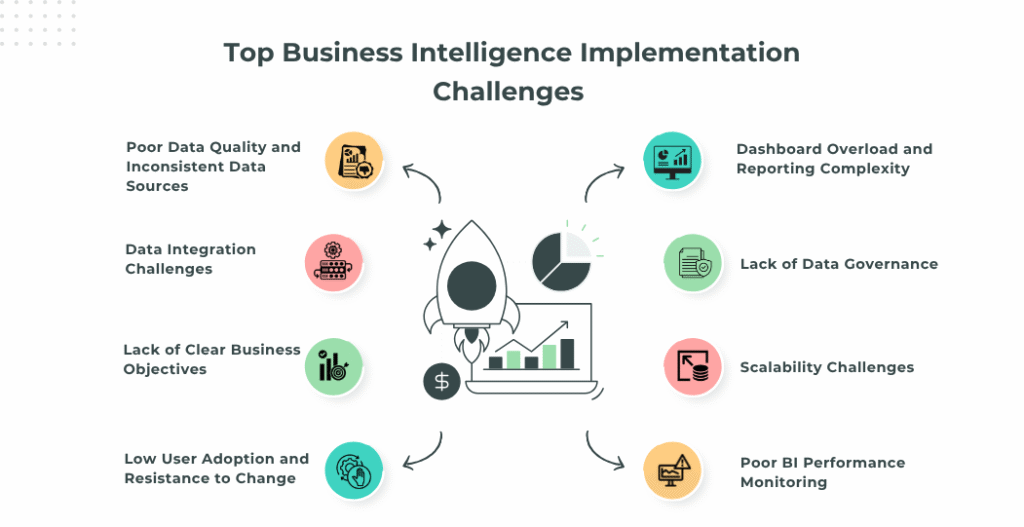
1. Poor Data Quality and Inconsistent Data Sources
Data quality remains one of the most significant barriers to BI success.
Even the most advanced Business Intelligence platform cannot generate reliable insights if the underlying data is inaccurate, incomplete, or inconsistent.
Common Problems Include:
- Duplicate customer records
- Missing information
- Inconsistent data formats
- Data silos across departments
- Conflicting reports
- Inaccurate analytics
For example, sales, marketing, and customer service teams may maintain separate customer records, resulting in multiple versions of the truth.
Best Practice
Organizations should establish a comprehensive data governance framework that includes:
- Data quality standards
- Validation rules
- Data ownership responsibilities
- Regular audits
- Automated cleansing processes
Improving data quality at the source ensures more reliable reporting and better business decisions.
2. Data Integration Challenges
Modern organizations use multiple software applications to manage different business functions.
Unfortunately, these systems often operate independently, making it difficult to create a unified view of business performance.
Common Problems
- ERP integration issues
- CRM integration issues
- Legacy system limitations
- Disconnected databases
- Manual data consolidation
When data remains fragmented across systems, reporting becomes slow, inconsistent, and prone to errors.
Best Practice
Organizations should adopt an API-first integration strategy and create a unified data architecture that supports seamless data exchange between systems.
Key actions include:
- Centralizing data sources
- Implementing data warehouses
- Using integration platforms
- Automating data synchronization
A connected data ecosystem significantly improves reporting accuracy and operational visibility.
3. Lack of Clear Business Objectives
Many BI projects begin with enthusiasm but lack clearly defined goals.
Without specific objectives, organizations often build dashboards that provide information but fail to drive meaningful business outcomes.
Common Problems
- Excessive dashboards
- Undefined KPIs
- Lack of measurable outcomes
- Conflicting stakeholder expectations
When success metrics are unclear, it becomes difficult to evaluate the effectiveness of the implementation.
Best Practice
Start by defining business goals before selecting tools or designing reports.
Organizations should:
- Identify key business challenges
- Define measurable objectives
- Establish KPI frameworks
- Align dashboards with strategic priorities
A strong Business Intelligence strategy ensures every report contributes to business value.
4. Low User Adoption and Resistance to Change
Technology alone cannot create a data-driven culture.
Employees must trust and actively use BI systems for implementation success.
Common Problems
- Continued reliance on spreadsheets
- Underutilized dashboards
- Lack of confidence in reports
- Resistance to new workflows
If employees do not adopt the platform, the organization will struggle to realize its BI investment.
Best Practice
Successful organizations prioritize change management and user engagement.
Recommended approaches include:
- Comprehensive user training
- Stakeholder involvement
- Clear communication of benefits
- Department-specific dashboard design
- Ongoing support programs
When users understand how BI improves their daily work, adoption rates increase significantly.
5. Dashboard Overload and Reporting Complexity
One of the most common mistakes in Business Intelligence implementation is attempting to display too much information.
While organizations often want maximum visibility, excessive reporting can overwhelm users.
Common Problems
- Too many dashboards
- Information overload
- Complex navigation
- Low report engagement
- Difficulty identifying critical insights
Users may spend more time searching for information than acting on it.
Best Practice
Focus on simplicity and relevance.
Organizations should create:
- Role-based dashboards
- KPI-focused reports
- Action-oriented visualizations
- Clear reporting hierarchies
Effective Business Intelligence dashboards help users identify insights quickly and confidently.
6. Lack of Data Governance
Data governance establishes the rules, standards, and accountability required for consistent data management.
Without governance, organizations often face conflicting reports and inconsistent metrics.
Common Problems
- Multiple report versions
- Different KPI definitions
- Security vulnerabilities
- Compliance concerns
- Data ownership confusion
These issues can reduce confidence in BI reporting solutions.
Best Practice
Implement a formal governance framework that includes:
- Defined data ownership
- Standardized metrics
- Security policies
- Data access controls
- Compliance monitoring
Strong governance creates trust and consistency across the organization.
7. Scalability Challenges
As organizations grow, so does the volume of data they generate.
A BI system that performs well today may struggle to support future growth if scalability is not considered during implementation.
Common Problems
- Slow dashboard performance
- Increasing storage requirements
- Infrastructure bottlenecks
- Delayed reporting
Performance issues can negatively impact user experience and adoption.
Best Practice
Design BI infrastructure with scalability in mind.
Organizations should consider:
- Cloud-based BI architecture
- Scalable data warehouses
- Performance optimization strategies
- Automated resource allocation
A scalable architecture ensures long-term BI success.
8. Poor BI Performance Monitoring
Many organizations focus on implementation but fail to monitor ongoing performance.
Without measurement, it becomes difficult to determine whether BI investments are delivering business value.
Common Problems
- No ROI tracking
- Low dashboard usage visibility
- Unclear business impact
- Limited optimization efforts
Best Practice
Organizations should continuously measure:
- Dashboard usage rates
- KPI achievement
- User engagement
- Reporting accuracy
- Business outcomes
Regular reviews enable continuous improvement and maximize return on investment.
Real-World BI Implementation Example
Sales Dashboard Transformation for a Multi-Location Business
A growing retail organization operated multiple locations and relied on separate systems for sales, inventory, and customer management.
Challenge
The business faced several reporting challenges:
- Data spread across CRM systems
- Sales information stored in spreadsheets
- ERP-generated operational reports
- Manual report consolidation
- Delayed decision-making
Management lacked a centralized view of business performance.
Solution
A centralized Business Intelligence solution was implemented that included:
- Data integration from CRM, ERP, and Excel sources
- Automated data synchronization
- Real-time Business Intelligence dashboards
- Executive KPI reporting
- Performance monitoring tools
Business Impact
The organization achieved:
- Faster decision-making
- Improved reporting accuracy
- Enhanced operational visibility
- Reduced manual reporting effort
- Better strategic planning capabilities
This example highlights how a well-planned BI implementation can transform fragmented data into actionable business insights.
Business Intelligence Implementation Best Practices
Organizations that achieve successful BI outcomes typically follow a structured implementation approach.
- Start with Business Goals: Define clear objectives before selecting technology platforms or building dashboards.
- Focus on Data Quality: Establish data cleansing, validation, and governance processes early in the project.
- Prioritize Critical KPIs: Track the metrics that directly support business objectives rather than measuring everything.
- Implement in Phases: Roll out BI capabilities gradually to reduce risk and improve adoption.
- Train End Users: Provide role-based training to ensure employees understand how to use Business Intelligence tools effectively.
- Establish Data Governance: Create standards for data ownership, security, quality, and reporting consistency.
- Monitor and Optimize Continuously: Regularly review system performance, user adoption, and business outcomes to drive continuous improvement.
How Codeflix Helps Businesses Implement Business Intelligence Solutions
At Codeflix, we help organizations transform complex business data into meaningful insights through customized Business Intelligence solutions.
Our Business Intelligence services include:
- Business Intelligence Consulting: We assess your existing data environment and develop a tailored BI strategy aligned with your business goals.
- Dashboard Development: Our team designs intuitive and interactive Business Intelligence dashboards that provide real-time visibility into business performance.
- Data Integration Services: We integrate ERP systems, CRM platforms, databases, spreadsheets, and third-party applications into a centralized reporting environment.
- KPI Design and Reporting: We help organizations define meaningful KPIs and build reporting frameworks that support data-driven decision making.
- Predictive Analytics Integration: Leverage advanced analytics to identify trends, forecast outcomes, and support proactive business strategies.
- Real-Time Reporting Solutions: Access accurate business insights whenever you need them through automated reporting and live dashboards.
- Ongoing Optimization and Support: We continuously monitor, optimize, and enhance BI environments to ensure long-term success and maximum ROI.
Ready to Turn Business Data into Actionable Insights?
Many organizations struggle with fragmented data, disconnected systems, inconsistent reporting, and limited business visibility. Whether you need real-time dashboards, advanced reporting solutions, KPI tracking, or a complete Business Intelligence implementation, Codeflix can help.
Our experts design and implement scalable Business Intelligence solutions that transform raw business data into actionable insights, enabling smarter decision-making, improved efficiency, and sustainable growth.
Contact Codeflix today to discover how Business Intelligence can unlock the full value of your business data.
FAQ
What are the biggest Business Intelligence implementation challenges?
The most common Business Intelligence implementation challenges include poor data quality, data integration issues, low user adoption, lack of governance, scalability concerns, and unclear business objectives.
Why do Business Intelligence projects fail?
BI projects often fail due to inadequate planning, poor data management, unclear KPIs, weak stakeholder engagement, and insufficient user adoption strategies.
How long does BI implementation take?
The implementation timeline depends on project complexity, data sources, integrations, and business requirements. Small projects may take a few weeks, while enterprise-scale implementations can take several months.
What are Business Intelligence best practices?
Key BI best practices include defining business goals, maintaining data quality, implementing governance policies, prioritizing KPIs, training users, and continuously monitoring performance.
How can businesses improve BI adoption?
Organizations can improve adoption by involving stakeholders early, providing user training, designing intuitive dashboards, and demonstrating measurable business value.
What is the role of data governance in BI?
Data governance ensures consistency, accuracy, security, and accountability across all business data used in reporting and analytics.
How do BI dashboards improve decision-making?
Business Intelligence dashboards provide real-time visibility into key metrics, helping leaders identify trends, monitor performance, and make informed decisions faster.
What industries benefit most from Business Intelligence solutions?
Industries including manufacturing, retail, healthcare, finance, logistics, education, telecommunications, and professional services can significantly benefit from Business Intelligence solutions and data-driven decision making.