
Understanding the difference between business intelligence and business analytics is essential for organizations aiming to turn data into measurable business value. While both fall under the same category of a larger data umbrella, they cater to various decision-making timelines. In simple words, business intelligence specializes in what has already happened. while business analytics deals with what might happen in the future. It is a classification between descriptive reporting and predictive or prescriptive modeling. Knowing about this distinction is key in terms of finalizing the right tools, hiring the right talent, and giving importance to initiatives that align with our business goals
In this blog, we’ll explore definitions, capabilities, tools, use cases, governance, and future trends so that you can confidently decide when to focus on BI or where to move into BA, and in some scenarios, how effectively we can integrate both for the greatest impact
Quick Summary: Business Intelligence vs Business Analytics
Business Intelligence (BI): This is often about descriptive and diagnostic analysis. It collects data from various sources, cleans it up, and shares it through dashboards and reports to explain what has happened and why.
Business Analytics (BA): This is generally more towards predictive and prescriptive analysis. It uses machine learning, statistical models, and optimization techniques to predict future outcomes and provide a plan of action
If your motive is to gain operational visibility and track performance, then BI is your choice. On the other hand, if you are looking to find out what will happen and enhance decisions, BA is the best option.
What is business intelligence? (BI)
Business intelligence deals with the collection, organization, and visualization of both past and current data to make decisions. BI supports answering questions like
– What happened last quarter?
– Which items are performing better?
– Where exactly do we fall short of our targets?
– Which segments or areas are trailing behind, and why?
Core Components of BI
What is business analytics? (BA)
Core Components of BA:
Outcomes BA Enables:
Key Differences Between Business Intelligence and Business Analytics:
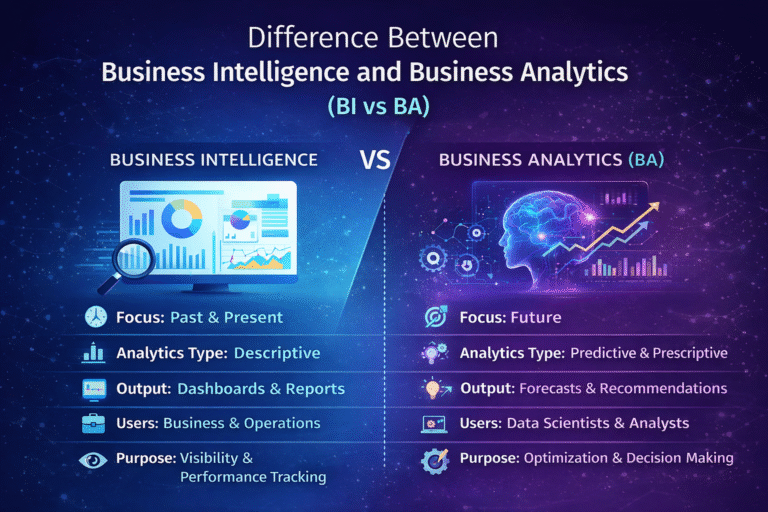
Time Orientation:
Question Types:
Techniques:
Data Types & Complexity:
Users:
Outputs:
Value Horizon:
Common Overlaps and Misconceptions
Benefits: BI vs BA
BI Benefits:
BA Benefits:
Tools and Technology Stack
BI Stack
BA Stack
Data Maturity Stages: When to Use BI or BA
Stage 0 – Fragmented Data:
Stage 1 – Centralized Reporting:
Stage 2 – Analytical Scaling:
Stage 3 – Decision Automation:
Use Cases by Industry
Retail & E-commerce
Financial Services
Manufacturing
Healthcare
Telecom
SaaS/Tech
Metrics and KPIs: BI vs BA
BI-Focused KPIs:
BA-Focused Outputs & Metrics:
Team Roles and Skills
Key Skills:
Implementation Roadmap
Governance, Security, and Compliance
Cloud, Real-Time, and AI Impact
Cost, ROI, and Pitfalls
Cost Drivers
- Data warehousing and integration.
- Tool licensing and cloud computing
- Talent acquisition and training support
- MLOps and monitoring infrastructure
ROI Levers
- Boosting revenue through personalization, smart pricing, and cross-selling
- minimizing costs with automation and optimization
- preventing risks and enhancing compliance efficiency
- Speeding up decision-making while ensuring consistency.