
Introduction
Today’s customers expect businesses to respond quickly, accurately, and at any time of the day. Whether they’re asking about a product, checking an order status, or requesting technical support, long wait times often lead to frustration and missed business opportunities. In fact, many businesses lose potential customers simply because they cannot respond when inquiries arrive outside business hours.
At the same time, support teams are handling increasing volumes of customer conversations across websites, email, live chat, social media, and messaging apps. Managing these interactions manually is becoming both costly and inefficient.
This is where an AI chatbot for business can make a significant difference. Powered by technologies such as Artificial Intelligence (AI), Natural Language Processing (NLP), Machine Learning (ML), and Generative AI, modern chatbots can understand customer intent, automate conversations, qualify leads, and provide instant support around the clock.
In this guide, you’ll learn how AI chatbots work, why businesses are adopting them, their key features, benefits, and how they help improve customer support, sales, and overall business productivity.
What Is an AI Chatbot for Business?
An AI chatbot for business is an intelligent virtual assistant that uses artificial intelligence to understand customer queries, automate conversations, qualify leads, and provide instant support across multiple communication channels
Unlike traditional rule-based chatbots that only respond to predefined commands, an AI chatbot understands natural language, recognizes user intent, learns from interactions, and provides more relevant responses over time.
Modern business AI chatbots combine several AI technologies:
- Natural Language Processing (NLP) to understand human language.
- Machine Learning to improve responses using previous interactions.
- Generative AI to create natural, conversational responses instead of relying solely on scripted replies.
Businesses are increasingly adopting AI chatbot software because it helps reduce response times, improve customer engagement, automate repetitive tasks, and provide consistent support across multiple channels. Whether deployed on a website, mobile app, or messaging platform, an AI chatbot solution enables organizations to serve customers more efficiently while allowing employees to focus on higher-value tasks.
Why Businesses Need AI Chatbots
Customer expectations have changed dramatically over the last few years. People expect immediate responses, personalized assistance, and seamless experiences regardless of the communication channel they choose.
Here are some of the biggest challenges businesses face today.
Rising Customer Expectations
Customers no longer want to wait hours—or even minutes—for simple answers. They expect businesses to be available whenever they need assistance. An AI customer service chatbot can instantly answer common questions and improve customer satisfaction.
Growing Support Volumes
As businesses grow, so do customer inquiries. Without automation, support teams often struggle to keep up, resulting in delayed responses and overwhelmed employees. Customer support automation helps manage increasing workloads without proportionally increasing staffing costs.
Limited Support Teams
Many small and mid-sized businesses operate with limited customer support resources. AI chatbots can handle routine inquiries automatically, allowing human agents to focus on complex issues that require personal attention.
Lost Sales Opportunities
Potential customers frequently visit business websites outside normal working hours. Without immediate engagement, these visitors may leave and purchase from competitors.
For example, imagine a customer visiting your website at 11 PM to inquire about pricing. Without an AI sales chatbot, the question remains unanswered until the next business day. An AI chatbot can instantly provide pricing information, qualify the lead, collect contact details, and even schedule a product demonstration—keeping the sales process moving even when your team is offline.
Increasing Operational Costs
Hiring additional support agents to provide round-the-clock service is expensive. AI chatbots reduce operational costs by automating repetitive conversations while maintaining a high level of service quality.
Need for 24/7 Customer Support
Businesses today serve customers across different cities, countries, and time zones. An AI chatbot for business ensures support is available 24/7, helping organizations deliver consistent customer experiences without expanding support teams.
How AI Chatbots Work
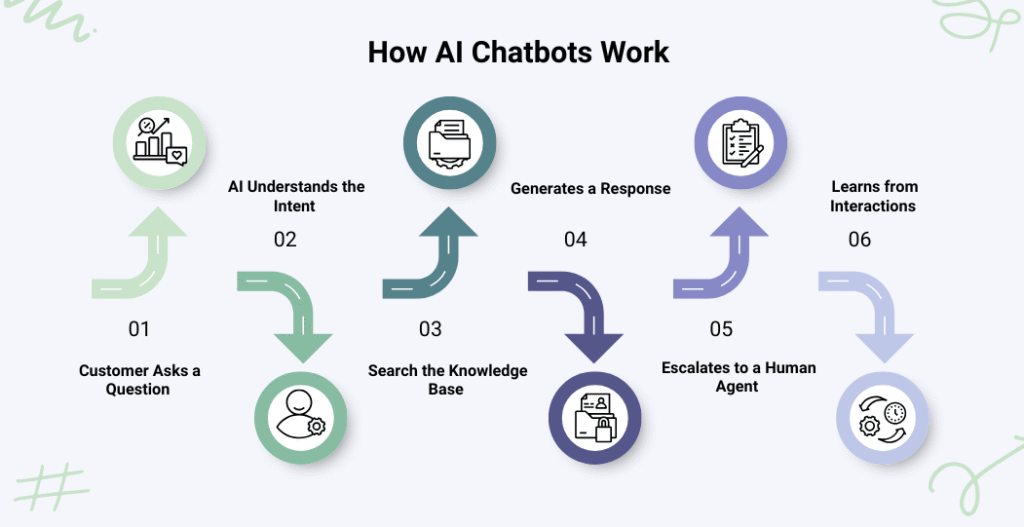
Although AI chatbots seem conversational, they follow a structured process behind the scenes to understand requests and generate meaningful responses.
Step 1: Customer Asks a Question
The interaction begins when a customer submits a query through a website chatbot, mobile application, WhatsApp, live chat, or another communication channel.
Step 2: AI Understands the Intent
Using Natural Language Processing (NLP), the chatbot analyzes the customer’s message to determine its intent rather than simply matching keywords.
Step 3: Search the Knowledge Base
The chatbot searches relevant information from FAQs, company documentation, CRM records, helpdesk articles, or integrated business systems to identify the best possible answer.
Step 4: Generates a Response
Using AI and, in many cases, Generative AI, the chatbot creates a natural response that directly addresses the customer’s question.
Step 5: Escalates to a Human Agent
If the request is too complex or requires human judgment, the chatbot seamlessly transfers the conversation to a support representative along with the conversation history, reducing the need for customers to repeat themselves.
Step 6: Learns from Interactions
Machine Learning helps the chatbot improve over time by analyzing previous conversations, identifying successful responses, and continuously enhancing future interactions.
Key Features of an AI Chatbot for Business
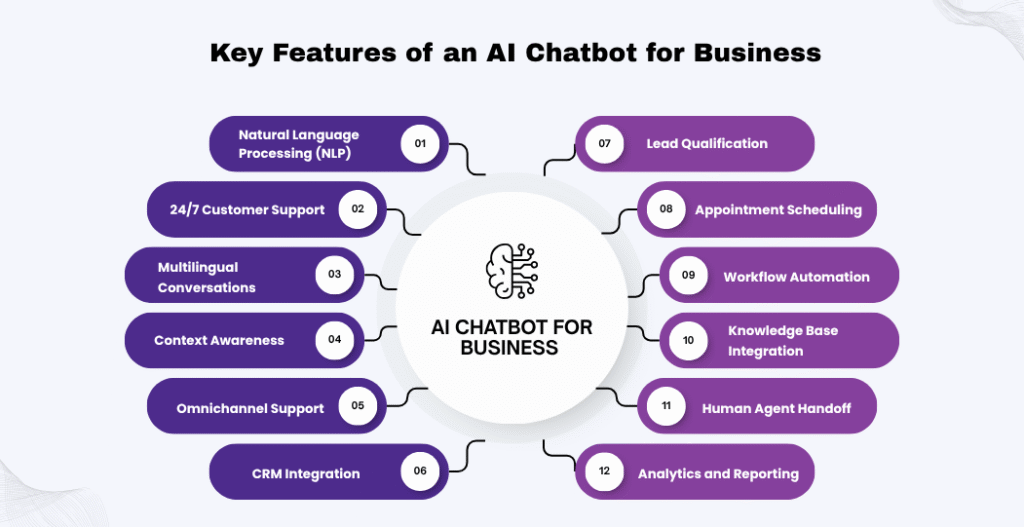
Selecting the right AI chatbot software requires understanding the features that directly impact customer experience and operational efficiency.
Natural Language Processing (NLP)
NLP enables chatbots to understand conversational language instead of relying on exact keyword matches. This allows customers to communicate naturally while receiving accurate responses.
24/7 Customer Support
An AI customer support chatbot remains available around the clock, ensuring customers receive immediate assistance regardless of business hours or time zones.
Multilingual Conversations
Businesses serving diverse audiences can provide support in multiple languages, improving accessibility and customer satisfaction without maintaining multilingual support teams.
Context Awareness
Modern chatbots remember previous interactions within a conversation, allowing them to provide relevant responses instead of treating every question as a new request.
Omnichannel Support
An AI chatbot solution can work across websites, WhatsApp, Facebook Messenger, live chat, and other communication channels, delivering a consistent customer experience.
CRM Integration
By integrating with CRM systems, chatbots can access customer history, previous interactions, and purchase records, enabling personalized conversations and better lead management.
Lead Qualification
Instead of simply answering questions, an AI sales chatbot can identify qualified prospects, collect business requirements, and route high-value leads directly to the sales team.
Appointment Scheduling
Chatbots can automatically schedule meetings, product demos, consultations, or service appointments by integrating with business calendars.
Workflow Automation
AI chatbots can automate repetitive business processes such as creating support tickets, routing customer requests, triggering approval workflows, and sending follow-up notifications. This improves operational efficiency while reducing manual effort.
Knowledge Base Integration
Connecting the chatbot with an organization’s knowledge base enables customers to receive accurate answers based on the latest documentation, FAQs, and support articles.
Human Agent Handoff
When AI reaches its limits, customers should be able to transition seamlessly to a human support representative without losing conversation context.
Analytics and Reporting
Advanced AI chatbot software provides detailed insights into conversation volume, customer satisfaction, response accuracy, lead generation, and overall chatbot performance, helping businesses continuously improve customer engagement.
Expert Insight: Building AI Chatbots That Deliver Business Value
Many businesses assume that deploying a chatbot is simply about adding a chat window to their website. In reality, the most effective AI chatbot implementations are integrated with existing business systems and designed around specific business goals.
For example, a chatbot that connects with a CRM can personalize customer interactions, while integration with a helpdesk system enables automatic ticket creation and faster issue resolution. Workflow automation further enhances efficiency by routing requests, triggering notifications, and reducing manual tasks.
At Codeflix, AI chatbot solutions are designed to go beyond conversational support. By integrating chatbots with CRM platforms, helpdesk software, and business workflows, organizations can automate routine processes, improve customer engagement, and create a more connected digital experience tailored to their operational needs.
Benefits of AI Chatbots for Businesses
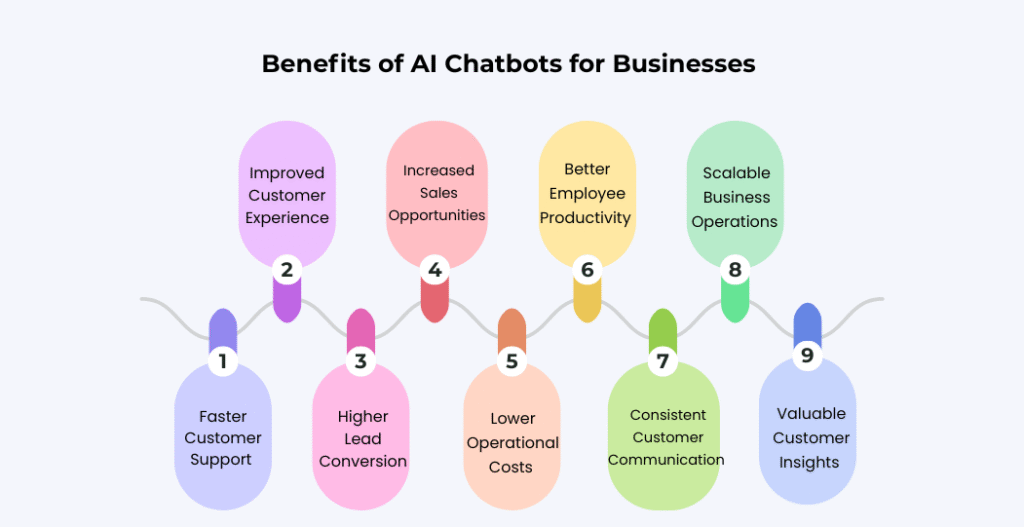
Implementing an AI chatbot for business is more than a technology upgrade—it is a strategic investment that improves customer engagement, streamlines operations, and supports business growth. Here are some of the key benefits.
Faster Customer Support
Customers expect immediate responses, especially for common questions. An AI customer support chatbot can instantly answer FAQs, share product information, track orders, or create support tickets without waiting for a human agent. This reduces response times and helps improve customer satisfaction.
Improved Customer Experience
AI chatbots provide consistent, personalized, and always-available support. By understanding customer intent and conversation context, they deliver more relevant responses, creating a smoother and more engaging customer experience across every interaction.
Higher Lead Conversion
Many website visitors leave without making an inquiry because they cannot find the information they need. An AI sales chatbot engages visitors in real time, answers product questions, captures contact details, and qualifies leads before routing them to the sales team, increasing the chances of conversion.
Increased Sales Opportunities
An AI chatbot doesn’t just respond to customer questions—it can also recommend products, promote relevant services, and encourage customers to take the next step. By engaging visitors at the right moment, businesses can generate more sales opportunities without increasing their sales team.
Lower Operational Costs
Automating repetitive customer conversations reduces the workload on support agents. Businesses can handle a larger volume of inquiries without significantly expanding their support teams, resulting in lower operational costs while maintaining service quality.
Better Employee Productivity
When chatbots handle routine tasks such as answering FAQs, booking appointments, and collecting customer information, employees have more time to focus on complex customer issues, strategic initiatives, and relationship building.
Consistent Customer Communication
Unlike manual support, AI chatbots deliver consistent responses based on approved business information. This reduces misinformation, improves service quality, and ensures customers receive reliable answers regardless of when they contact the business.
Scalable Business Operations
As businesses grow, customer inquiries increase. An AI chatbot solution can manage thousands of simultaneous conversations, making it easier to scale customer support without compromising response quality.
Valuable Customer Insights
Every customer interaction provides useful business data. Chatbot analytics help organizations understand common customer questions, buying behavior, support trends, and service gaps, enabling better business decisions and continuous improvement.
Real-World AI Chatbot Use Cases
AI chatbots are being used across industries to automate repetitive tasks, improve customer service, and enhance operational efficiency.
Manufacturing
Manufacturing companies use AI chatbots to assist vendors, provide machine maintenance information, answer employee queries, and automate internal IT support requests. This reduces downtime and improves communication across departments.
Healthcare
Healthcare providers use chatbots for appointment scheduling, patient FAQs, prescription reminders, and basic symptom guidance. Patients receive faster assistance while administrative staff spend less time handling routine inquiries.
Education
Educational institutions deploy chatbots to manage admission inquiries, recommend suitable courses, answer frequently asked questions, and provide student support throughout the enrollment process.
Retail and E-commerce
Retail businesses use AI chatbots on their websites to help customers discover products, track orders, process return requests, answer payment questions, and recommend complementary products based on browsing behavior. For example, an AI chatbot can recommend products based on browsing behavior, answer shipping questions in real time, and recover abandoned purchase journeys through proactive engagement.
Banking and Finance
Financial institutions leverage conversational AI to handle loan inquiries, provide account information, guide customers through service requests, and simplify fraud reporting while maintaining secure communication.
Real Estate
Real estate companies use AI chatbots to recommend properties based on customer preferences, qualify potential buyers, answer project-related questions, and schedule property visits automatically.
IT and SaaS Companies
Technology companies rely on AI chatbots for customer onboarding, password resets, technical troubleshooting, subscription management, and knowledge base assistance, allowing support teams to focus on complex technical issues.
AI Chatbot vs Rule-Based Chatbot
Although both chatbot types automate conversations, their capabilities differ significantly
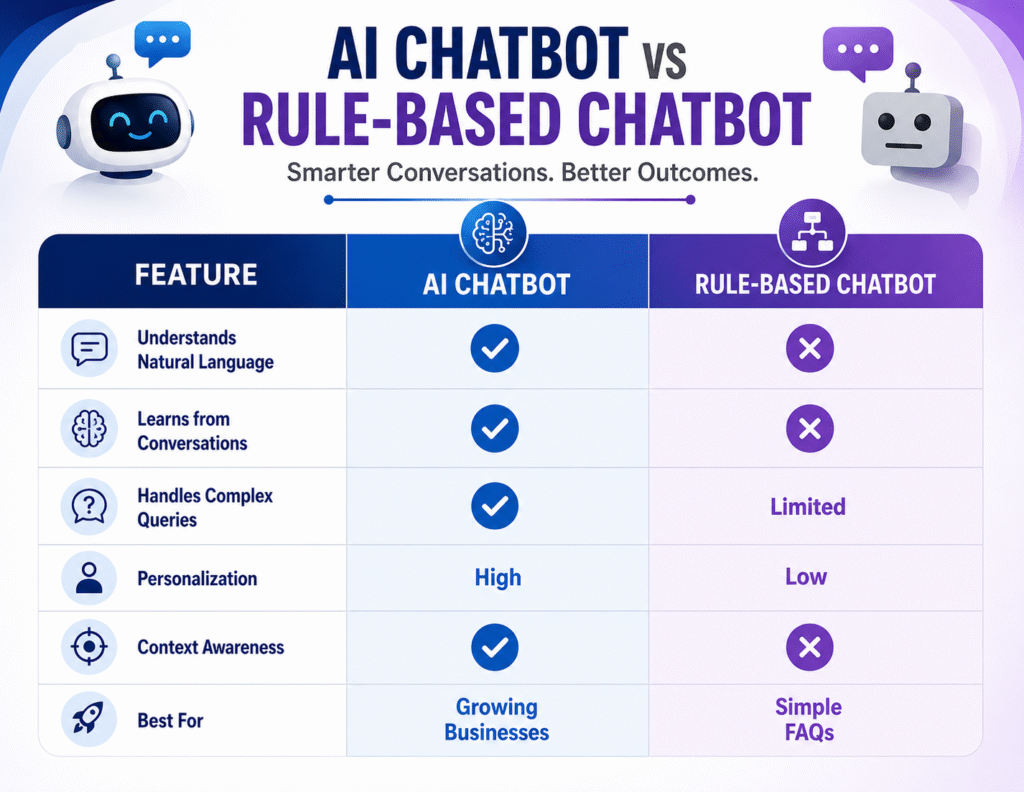
For businesses looking to improve customer engagement, automate sales, and provide personalized support, an AI chatbot for business offers significantly greater flexibility and long-term value than a traditional rule-based chatbot.
Common Mistakes Businesses Make When Implementing AI Chatbots
While AI chatbots offer significant advantages, their success depends on proper planning and implementation. Avoid these common mistakes:
- Deploying a chatbot without clear business goals, resulting in limited value.
- Ignoring CRM and business system integration, which prevents personalized customer interactions.
- Not training the chatbot with accurate business knowledge, leading to poor responses.
- Over-automating conversations without providing an easy way to reach a human agent.
- Failing to monitor chatbot performance, making it difficult to identify improvement opportunities.
- Neglecting regular updates, causing outdated information and reduced customer trust.
Treat your chatbot as a continuously improving business tool rather than a one-time implementation
How to Choose the Right AI Chatbot for Your Business
Choosing the right AI chatbot software requires evaluating both current needs and future business goals. One common mistake businesses make is selecting a chatbot based solely on AI capabilities while overlooking integration requirements. In practice, organizations often achieve better results when the chatbot is aligned with existing CRM, helpdesk, and operational workflows.
Before selecting a solution, consider the following:
- Define your customer support, sales, or automation objectives.
- Identify the business processes you want to automate.
- Evaluate AI capabilities such as NLP, Generative AI, and context awareness.
- Ensure the chatbot supports CRM integration, helpdesk software, and other business applications.
- Choose a scalable solution that grows with your business.
- Prioritize security, user privacy, and compliance requirements.
- Review reporting and analytics capabilities to measure chatbot performance.
- Select a vendor that offers customization, implementation support, and ongoing optimization.
A chatbot should complement your business processes—not force your business to adapt to the software.
Future of AI Chatbots in Business
AI chatbots continue to evolve beyond basic customer support. Emerging technologies are enabling businesses to automate increasingly complex interactions while delivering more personalized customer experiences.
Some of the most important trends include:
- Generative AI for more natural conversations.
- Voice-enabled AI assistants for hands-free interactions.
- AI agents capable of completing business tasks independently.
- Hyper-personalization using customer data and behavior.
- Predictive customer support that anticipates issues before they occur.
- Emotion and sentiment analysis to better understand customer intent.
- Autonomous workflow automation across CRM, helpdesk, and enterprise systems.
As AI technology advances, chatbots will become an integral part of digital transformation strategies across industries.
Conclusion
Customer expectations continue to evolve, making fast, personalized, and always-available support a competitive advantage. An AI chatbot for business helps organizations meet these expectations by automating customer interactions, improving response times, qualifying leads, and streamlining everyday operations.
Beyond customer support, modern AI chatbot solutions contribute to higher productivity, better employee efficiency, valuable business insights, and scalable growth. The key to success is choosing a solution that aligns with your business objectives, integrates seamlessly with existing systems, and evolves alongside your operational needs.
At Codeflix, we help businesses implement customized AI chatbot solutions that integrate with CRM platforms, helpdesk software, and workflow automation systems. By combining conversational AI with business process automation, organizations can deliver exceptional customer experiences while improving operational efficiency and driving long-term business growth.
FAQ
What is an AI chatbot for business?
An AI chatbot for business is an intelligent virtual assistant that uses artificial intelligence to automate customer conversations, answer questions, qualify leads, and support business processes across multiple communication channels.
How does an AI chatbot work?
AI chatbots use natural language processing, machine learning, and generative AI to understand customer intent, retrieve relevant information, generate responses, and escalate complex requests to human agents when necessary.
What are the benefits of AI chatbots?
AI chatbots improve response times, enhance customer experience, reduce operational costs, automate repetitive tasks, increase lead conversions, and provide valuable business insights through analytics.
Can AI chatbots replace human agents?
No. AI chatbots are best suited for handling repetitive and routine interactions. Human agents remain essential for resolving complex issues, providing empathy, and making business decisions that require judgment.
What is the difference between AI and rule-based chatbots?
Rule-based chatbots follow predefined scripts and decision trees, whereas AI chatbots understand natural language, learn from interactions, and handle more complex customer conversations.
Can AI chatbots integrate with CRM software?
Yes. Most modern AI chatbot solutions support CRM integration, allowing businesses to personalize conversations, access customer history, and improve sales and support workflows.
Are AI chatbots suitable for small businesses?
Absolutely. Small businesses can use AI chatbots to provide 24/7 customer support, capture leads, automate repetitive tasks, and improve customer engagement without significantly increasing operational costs.
How much does an AI chatbot cost?
The cost depends on factors such as features, AI capabilities, customization, integrations, and implementation requirements. Businesses should evaluate solutions based on long-term value rather than price alone.
Which industries benefit most from AI chatbots?
AI chatbots are widely used across manufacturing, healthcare, education, retail, banking, real estate, IT, SaaS, logistics, and many other industries where customer communication and process automation are important.
How long does AI chatbot implementation take?
Implementation timelines vary depending on project complexity, integrations, and customization. Simple chatbot deployments may take a few weeks, while enterprise implementations integrated with CRM, helpdesk, and workflow systems typically require additional planning and testing