
Introduction
Every business collects data every day. Sales records, customer interactions, website visits, inventory updates, and financial transactions all generate valuable information. However, having data alone is not enough. The real value comes from understanding what that data means and using it to make better business decisions.
This is where predictive analytics software becomes useful. Instead of only showing what happened in the past, it helps businesses identify patterns, predict future outcomes, and plan with greater confidence. Whether it’s forecasting sales, reducing customer churn, managing inventory, or improving operational efficiency, predictive analytics software turns data into meaningful insights.
Choosing the right software, however, is not always straightforward. Every business has different goals, data sources, and system requirements. The ideal solution should fit your business needs, integrate with your existing applications, and be easy for your team to use.
In this guide, you’ll learn what predictive analytics software is, how it works, the features to look for, its business benefits, and how to choose the right solution for your organization.
What Is Predictive Analytics Software?
Predictive analytics software is a business solution that analyzes historical and real-time data using artificial intelligence (AI), machine learning, and statistical models to predict future outcomes and support better decision-making.
Unlike traditional reporting tools that focus on past performance, predictive analytics software looks ahead. It studies patterns in your business data to estimate what is likely to happen next. This helps organizations prepare for future opportunities and reduce potential risks.
For example, a retail business can forecast product demand before the holiday season. A manufacturing company can predict equipment failures before they happen. A financial institution can identify transactions that may indicate fraud.
The software continuously learns from new data, making predictions more accurate over time. As businesses collect more information, the system improves its ability to recognize trends and provide reliable forecasts. Instead of relying on assumptions, organizations can use predictive analytics software to make informed decisions based on data.
How Predictive Analytics Software Works
Predictive analytics software follows a series of steps to transform raw business data into useful predictions. While the technology behind it is advanced, the overall process is easy to understand.
Data Collection
The first step is gathering data from different business systems. Depending on the organization, this may include:
- CRM systems
- ERP software
- Business applications
- IoT devices
- Databases
- Cloud platforms
Bringing data from multiple sources into one place gives the software a complete picture of business operations.
Data Preparation
Raw data often contains duplicate records, missing values, or incorrect information. Before analysis begins, the software cleans and organizes the data.
This process improves data quality and ensures the predictions are based on accurate and reliable information.
Model Building
Once the data is ready, the software applies AI, machine learning algorithms, and statistical models to identify patterns and relationships.
These models learn from historical data and continuously improve as new information becomes available.
Predictions and Insights
After analyzing the data, the software generates forecasts and actionable insights.
These may include:
- Sales forecasts
- Customer behavior predictions
- Inventory demand estimates
- Risk alerts
- Performance recommendations
- Interactive dashboards and reports
Instead of spending hours analyzing spreadsheets, decision-makers receive insights that help them respond quickly and confidently.
Key Features to Look for in Predictive Analytics Software
Not all predictive analytics platforms offer the same capabilities. Choosing software with the right features ensures you can make accurate predictions, improve efficiency, and support future business growth.
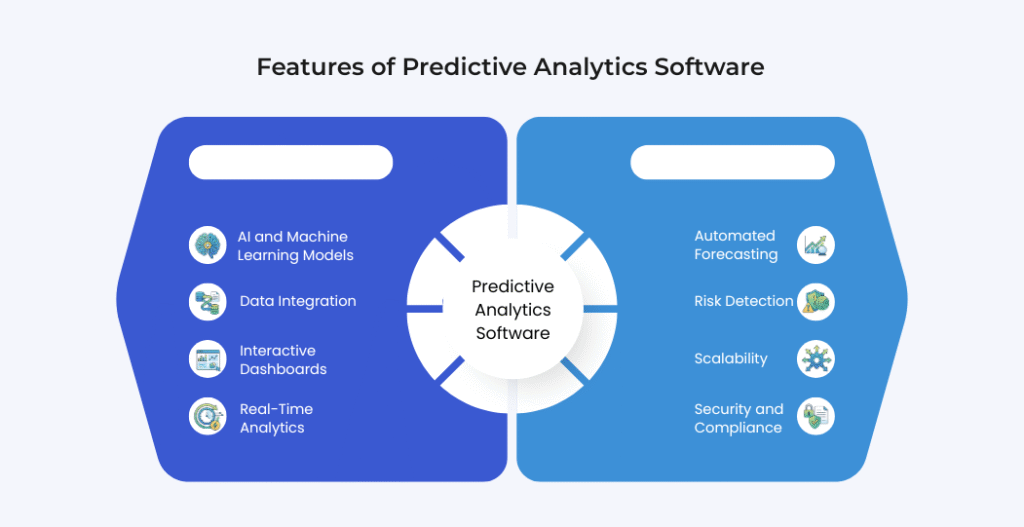
AI and Machine Learning Models
AI and machine learning are the foundation of predictive analytics software. These technologies analyze large volumes of data to identify patterns that may not be visible through manual analysis.
As more business data becomes available, the models continue learning and improve the accuracy of future predictions. This allows organizations to make better decisions with greater confidence.
Data Integration
A predictive analytics solution should easily connect with your existing business systems.
Common integrations include:
- CRM software
- ERP systems
- Business Intelligence platforms
- Cloud storage
- SQL databases
- Business applications
When all your business data is connected, the software can generate more accurate insights without requiring manual data transfers.
Interactive Dashboards
Large amounts of data are easier to understand when presented visually.
Interactive dashboards allow users to monitor business performance using:
- Charts
- Graphs
- KPIs
- Reports
- Trend analysis
These dashboards help managers quickly understand important information and take action when needed.
Real-Time Analytics
Business conditions can change quickly, and relying on outdated reports may lead to missed opportunities. Real-time analytics allows businesses to analyze live data as it is generated.
For example, a retailer can monitor sales throughout the day and identify products that are selling faster than expected. A logistics company can track delivery performance in real time and respond to delays immediately.
Access to up-to-date information helps businesses make faster and more informed decisions.
Automated Forecasting
One of the biggest advantages of predictive analytics software is its ability to automate forecasting.
Instead of creating forecasts manually, the software analyzes historical data and current trends to generate predictions automatically.
Businesses can forecast:
- Sales revenue
- Customer demand
- Inventory requirements
- Market trends
- Cash flow
- Resource utilization
Automated forecasting saves time, reduces manual effort, and improves planning across different departments.
Risk Detection
Every business faces risks, but identifying them early allows organizations to take preventive action.
Predictive analytics software can detect potential risks by analyzing patterns and identifying unusual behavior.
Some common examples include:
- Fraud detection in financial transactions
- Customer churn prediction
- Equipment failure prediction
- Credit risk assessment
- Supply chain disruptions
By receiving early warnings, businesses can reduce losses and improve overall operational stability.
Scalability
As businesses grow, the amount of data they generate also increases. A good predictive analytics platform should be able to handle larger datasets, more users, and additional business processes without affecting performance.
Scalable software ensures that organizations can continue using the same platform as their operations expand, avoiding the need for frequent system replacements.
Whether a business has a few employees or operates across multiple locations, the software should support future growth.
Security and Compliance
Business data often includes sensitive customer, financial, and operational information. Protecting this data is essential.
Look for predictive analytics software that offers features such as:
- Role-based user access
- Data encryption
- Audit logs
- Secure cloud storage
- Compliance with industry regulations
Strong security features help protect business information while ensuring that only authorized users can access critical data.
Business Benefits of Predictive Analytics Software
Predictive analytics software helps businesses make better use of their data by providing insights that support smarter planning and faster decision-making. Instead of relying on manual analysis or assumptions, organizations can make decisions based on reliable forecasts and trends.
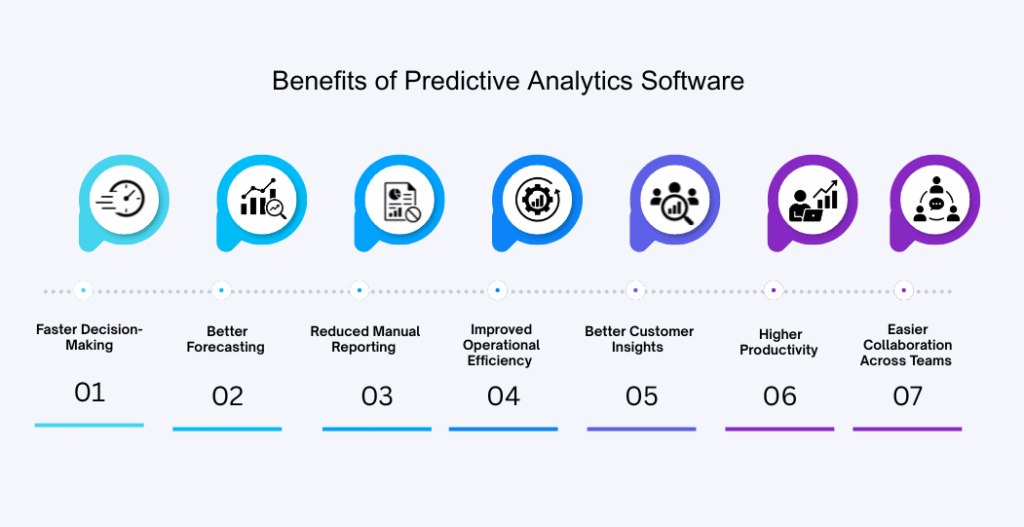
Faster Decision-Making
Interactive dashboards and automated insights provide decision-makers with the information they need without spending hours analyzing reports. This allows businesses to respond quickly to changing market conditions.
Better Forecasting
Accurate forecasts help businesses plan for future demand, allocate resources efficiently, and reduce uncertainty in budgeting and operations.
Reduced Manual Reporting
The software automatically collects, analyzes, and presents data, reducing the time employees spend creating reports manually. Teams can focus more on strategic activities instead of repetitive tasks.
Improved Operational Efficiency
By identifying trends and potential issues early, businesses can improve workflows, reduce delays, and optimize daily operations.
Better Customer Insights
Predictive analytics software helps organizations understand customer behavior, buying patterns, and preferences. These insights support personalized marketing, improved customer service, and stronger customer relationships.
Higher Productivity
Employees spend less time gathering and analyzing data because the software provides ready-to-use insights and recommendations. This improves productivity across departments.
Easier Collaboration Across Teams
When all departments have access to the same dashboards and reports, teams can work together more effectively. Sales, marketing, finance, and operations can make decisions based on consistent and reliable information.
Industries That Use Predictive Analytics Software
Predictive analytics software is used across many industries to improve planning, reduce risks, and support better business decisions.
Retail
Retail businesses use predictive analytics software to forecast customer demand, optimize inventory levels, and identify purchasing trends. This helps reduce stock shortages and avoid excess inventory.
Healthcare
Healthcare providers use predictive analytics software to improve patient care, predict hospital admissions, optimize resource allocation, and support early diagnosis based on historical medical data.
Manufacturing
Manufacturers use predictive analytics to monitor equipment performance, schedule preventive maintenance, and improve production planning. Predicting equipment failures helps reduce downtime and maintenance costs.
Banking and Financial Services
Banks and financial institutions use predictive analytics software to detect fraudulent transactions, assess credit risk, forecast financial performance, and improve customer retention strategies.
Logistics and Supply Chain
Logistics companies rely on predictive analytics to forecast delivery demand, optimize transportation routes, and identify potential supply chain disruptions before they affect operations.
E-commerce
Online businesses use predictive analytics software to recommend products, forecast sales, personalize customer experiences, and improve inventory management based on customer purchasing behavior.
Telecommunications
Telecommunication companies use predictive analytics to reduce customer churn, optimize network performance, predict service issues, and improve customer support.
As more organizations adopt data-driven decision-making, predictive analytics software continues to play an important role across different industries.
How to Choose the Right Predictive Analytics Software
Selecting predictive analytics software involves more than comparing features. The right solution should match your business objectives, integrate with your existing systems, and support future growth.
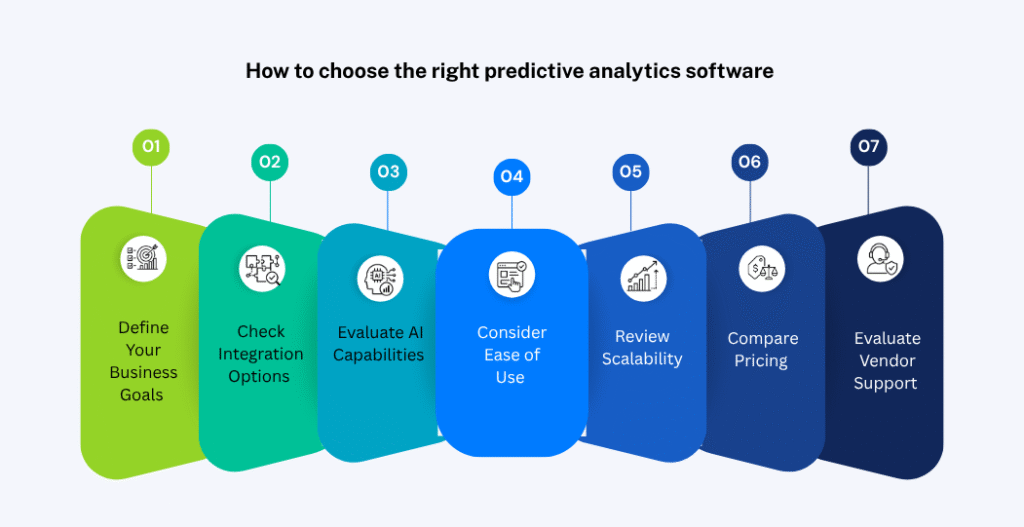
Define Your Business Goals
Start by identifying the problems you want to solve.
For example, your goal may be to:
- Improve sales forecasting
- Reduce customer churn
- Optimize inventory
- Detect fraud
- Improve operational efficiency
Having clear objectives makes it easier to evaluate different software options.
Check Integration Options
Your predictive analytics platform should work seamlessly with the tools your business already uses.
Look for integration with:
- CRM systems
- ERP software
- Business Intelligence tools
- Cloud platforms
- Databases
- Business applications
Smooth integration ensures data flows automatically between systems and improves the accuracy of predictions.
Evaluate AI Capabilities
Different software solutions offer different levels of AI functionality.
Consider whether the platform supports:
- Predictive modeling
- Automated forecasting
- Anomaly detection
- Machine learning
- Intelligent recommendations
Advanced AI capabilities can improve prediction accuracy and reduce manual effort.
Consider Ease of Use
The software should be easy for both technical and non-technical users.
Look for features such as:
- User-friendly dashboards
- Simple navigation
- Customizable reports
- Easy-to-understand visualizations
A shorter learning curve helps teams adopt the software more quickly.
Review Scalability
As your business grows, your software should be able to handle more users, larger datasets, and additional business requirements without affecting performance.
Choosing a scalable platform helps protect your investment over the long term.
Compare Pricing
Price is important, but it should not be the only factor.
Compare software based on:
- Available features
- Integration capabilities
- User limits
- Implementation costs
- Maintenance costs
- Long-term value
Selecting software that delivers measurable business benefits often provides better value than simply choosing the lowest-priced option.
Evaluate Vendor Support
Reliable vendor support is essential for successful implementation.
Before making a decision, check whether the provider offers:
- Product training
- Technical support
- Implementation assistance
- Documentation
- Regular software updates
Strong support services help businesses maximize the value of their predictive analytics investment
Expert Insight: Choosing Software Is Only the First Step
Many businesses invest in predictive analytics software expecting immediate improvements in decision-making and business performance. However, simply purchasing the software is not enough to achieve meaningful results.
To get the most value, the software must be integrated with your existing business systems and aligned with your operational goals. When predictive analytics works alongside CRM systems, Business Intelligence dashboards, workflow automation tools, AI solutions, and IoT platforms, it provides a complete view of your business and delivers more accurate, actionable insights.
A well-planned implementation also ensures that data flows smoothly between systems, reducing manual work and improving the reliability of predictions.
At Codeflix, we help businesses implement predictive analytics solutions that fit their unique requirements. Our team works closely with organizations to integrate predictive analytics with existing applications, streamline business processes, and deliver insights that support faster decisions, improved efficiency, and long-term growth.
For businesses looking to improve customer engagement, automate sales, and provide personalized support, an AI chatbot for business offers significantly greater flexibility and long-term value than a traditional rule-based chatbot.
Conclusion
Data has become one of the most valuable assets for modern businesses, but its true value lies in how effectively it is used. Predictive analytics software helps organizations transform data into actionable insights, enabling them to forecast trends, reduce risks, improve planning, and make faster, more confident decisions.
Choosing the right solution involves more than comparing features. Businesses should evaluate their objectives, integration requirements, scalability, ease of use, and long-term value before making a decision. A well-implemented predictive analytics platform not only improves forecasting but also supports better collaboration, operational efficiency, and sustainable business growth.
At Codeflix, we help businesses implement predictive analytics software that integrates seamlessly with CRM systems, Business Intelligence platforms, workflow automation tools, AI solutions, and IoT applications. Our team works closely with organizations to deliver scalable, data-driven solutions that support smarter decision-making, improved efficiency, and long-term business success.
FAQ
What is predictive analytics software?
Predictive analytics software is a business solution that uses historical and real-time data, artificial intelligence (AI), machine learning, and statistical models to forecast future outcomes. It helps organizations make informed decisions by identifying trends, predicting risks, and uncovering business opportunities
How does predictive analytics software work?
Predictive analytics software collects data from various business systems, cleans and organizes it, applies AI and machine learning models to identify patterns, and generates predictions through dashboards, reports, and alerts. These insights help businesses make proactive decisions instead of reacting to problems after they occur.
What industries use predictive analytics software?
Predictive analytics software is widely used across industries, including retail, healthcare, manufacturing, banking and financial services, logistics, e-commerce, telecommunications, and many other sectors that rely on data-driven decision-making
Is predictive analytics software suitable for small businesses?
Yes. Many predictive analytics platforms are designed for businesses of all sizes. Small businesses can use them to forecast sales, understand customer behavior, manage inventory, improve planning, and make better decisions without investing in large analytics teams.
What features should predictive analytics software have?
Some important features to look for include:
- AI and machine learning capabilities
- Data integration with existing systems
- Interactive dashboards
- Real-time analytics
- Automated forecasting
- Risk detection
- Scalability
- Strong security and compliance features
These capabilities help businesses gain accurate insights and support long-term growth.
Can predictive analytics software integrate with CRM systems?
Yes. Most modern predictive analytics software supports integration with CRM systems, ERP software, Business Intelligence platforms, databases, and cloud applications. Integration allows businesses to combine data from multiple sources and generate more accurate predictions.
How is predictive analytics software different from business intelligence tools?
Business Intelligence (BI) tools primarily focus on analyzing historical data and presenting reports that explain what has already happened. Predictive analytics software goes a step further by using AI and machine learning to forecast future outcomes, identify potential risks, and recommend actions based on data patterns.
Many organizations use both solutions together to gain a complete view of past performance and future opportunities.
How do choose the right predictive analytics software?
Start by identifying your business goals and evaluating how well the software aligns with them. Look for a solution that offers easy integration with your existing systems, strong AI capabilities, user-friendly dashboards, scalability, reliable security, transparent pricing, and dependable vendor support. Choosing software that fits your current and future needs will deliver greater long-term value.