
Introduction
IoT in business automation is rapidly transforming how enterprises reduce operational costs, improve efficiency, and make faster, data-driven decisions. From predictive maintenance to smart workplaces, businesses are increasingly using IoT automation solutions to create intelligent, connected operations.
What if your machines could warn you before a failure occurs? What if your office could automatically manage attendance, energy consumption, cafeteria tracking, and security without manual intervention? This is no longer a futuristic concept. IoT-driven business automation is already reshaping industries worldwide.
Businesses today face growing pressure to:
- Reduce operational costs
- Improve productivity
- Minimize manual processes
- Increase visibility across operations
- Enable faster decision-making
While traditional automation laid the foundation, the integration of the Internet of Things (IoT) is taking business automation to an entirely new level.
IoT enables machines, sensors, cameras, smart controllers, and connected devices to communicate in real time, collect actionable data, and trigger automated workflows without human intervention. The result is smarter operations, predictive intelligence, and measurable business outcomes across departments.
According to McKinsey, IoT could unlock $5.5 trillion in global economic value by 2030, with the largest impact expected across manufacturing, healthcare, logistics, and smart buildings. With more than 41 billion connected devices projected by 2027, businesses adopting enterprise IoT solutions today are gaining a major competitive advantage.
In this guide, we’ll explore:
- What IoT in business automation really means
- Real-world IoT automation use cases
- Benefits of IoT-powered automation
- Step-by-step IoT implementation strategies
- Key challenges and solutions
- How Codeflix delivers scalable IoT automation solutions
What Is IoT in Business Automation?
IoT in business automation refers to the use of connected devices — such as sensors, IP cameras, RFID systems, smart meters, and controllers — to collect real-time data from the physical world and automatically trigger workflows without manual intervention.
Unlike traditional rule-based automation, IoT-enabled automation is dynamic, intelligent, and adaptive. Devices continuously gather environmental and operational data to trigger automated actions based on real-time conditions. This makes IoT fundamentally different from earlier generations of automation systems.
A Practical Example
Instead of manually tracking employee attendance or cafeteria usage, an IoT-enabled system can:
- Identify employees automatically using facial recognition cameras
- Track individual meal consumption and sync it with payroll in real time
- Flag anomalies such as unauthorized access and trigger instant alerts
- Generate automated reports without manual data entry
This eliminates human error, reduces administrative workload, and provides management with actionable operational insights.
Why IoT Is a Game-Changer for Business Automation
IoT is not just an upgrade to traditional automation systems — it is a transformation layer that makes operations intelligent, measurable, and responsive in real time.
1. Real-Time Operational Visibility
IoT devices provide continuous live data streams, enabling businesses to monitor operations instantly instead of relying on delayed reports.
Managers gain:
- Real-time monitoring
- Instant alerts
- Live operational dashboards
- Faster decision-making capabilities
2. Predictive Decision-Making
One of the biggest advantages of IoT business automation is predictive intelligence.
Using IoT data and AI-powered analytics, businesses can:
- Predict equipment failures
- Detect unusual operational patterns
- Anticipate maintenance requirements
- Identify inefficiencies before they become costly problems
This shifts organizations from reactive management to proactive optimization.
3. Reduced Operational Costs
IoT automation solutions reduce:
- Manual labour
- Energy waste
- Equipment downtime
- Administrative overhead
Most enterprises implementing IoT solutions achieve measurable ROI within 12–18 months.
4. Seamless Integration with Existing Systems
Modern enterprise IoT platforms integrate with:
- CRM systems
- ERP software
- HR platforms
- Payroll systems
- Workflow automation tools
This creates a connected, data-driven ecosystem without replacing existing infrastructure.
5. Scalability Across Locations
Businesses can start with a single pilot deployment and gradually scale IoT implementation across departments, facilities, or global operations.
This phased approach minimizes risk while maximizing long-term value.
6. Improved Sustainability & Energy Efficiency
Smart business automation powered by IoT helps organizations:
- Reduce energy consumption
- Optimize resource utilization
- Lower carbon emissions
- Achieve ESG and sustainability goals
IoT vs Traditional Automation
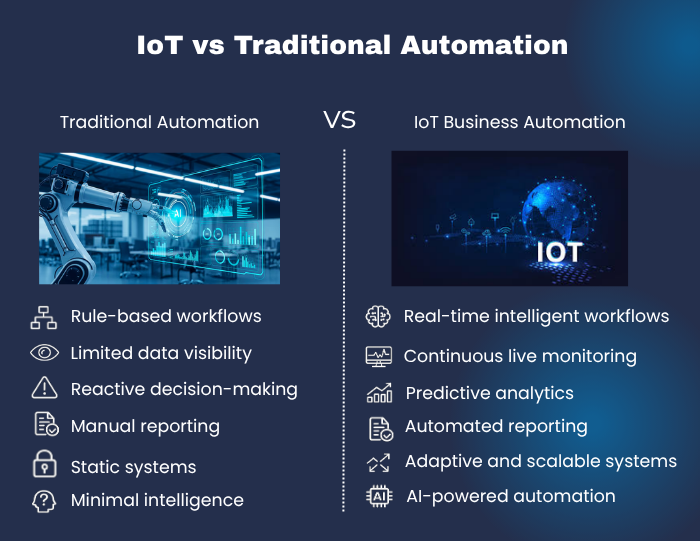
Real-World IoT Business Automation Use Cases
Here are some of the most impactful real-world IoT automation use cases transforming modern enterprises.
Use Case 1: Smart Workforce & Attendance Management
Traditional attendance systems often create problems such as proxy attendance, manual reconciliation, payroll discrepancies, and administrative inefficiencies.
IoT-based workforce automation eliminates these challenges entirely.
How It Works
- Facial recognition IP cameras automatically track employee entry and exit
- Attendance data syncs directly with HR and payroll systems
- Unauthorized access triggers real-time alerts
- Management dashboards provide workforce analytics instantly
Business Impact
- Eliminates proxy attendance
- Improves payroll accuracy
- Reduces HR administrative workload
- Enables real-time employee tracking and analytics
Codeflix Real-World Implementation — Smart Canteen Monitoring System
A client faced recurring billing inaccuracies due to manual cafeteria meal tracking across multiple counters.
Challenge
Manual meal tracking resulted in:
- Billing errors
- Administrative overhead
- Lack of consumption visibility
Solution
Codeflix deployed:
- IoT-enabled IP cameras
- Facial recognition systems
- Automated employee meal tracking
- Payroll-integrated workflow automation
Result
- 100% meal tracking accuracy
- Zero manual data entry
- Reduced administrative workload
- Complete management transparency
The entire solution was deployed within weeks.
Use Case 2: Predictive Maintenance in Manufacturing
Unplanned downtime costs manufacturers billions annually. IoT-powered predictive maintenance helps organizations identify issues before failures occur.
How It Works
- Sensors monitor vibration, temperature, pressure, and electrical activity
- Data is analyzed in real time using AI and cloud platforms
- Machine learning models detect anomalies before breakdowns happen
- Automated alerts notify maintenance teams instantly
Business Impact
- Up to 50% reduction in unplanned downtime
- Lower maintenance costs
- Increased equipment lifespan
- Safer working environments
Use Case 3: Smart Energy Management
Energy costs remain one of the largest operational expenses for enterprises.
IoT-enabled energy management systems optimize energy consumption automatically.
How It Works
- Smart sensors monitor energy usage across facilities
- Systems automatically power down unused equipment
- AI analyzes consumption trends and recommends optimizations
- Facility managers gain real-time visibility through dashboards
Business Impact
- 20–30% reduction in energy costs
- Lower carbon footprint
- Better sustainability compliance
- Improved utility forecasting
Use Case 4: IoT-Based Asset Tracking & Inventory Management
Manual asset tracking is inefficient and error-prone.
IoT business solutions provide real-time visibility into physical assets across warehouses, logistics operations, and enterprise environments.
How It Works
- GPS tags and IoT sensors track asset location and condition
- Real-time dashboards display movement and utilization
- Automated alerts trigger for unauthorized movement
- Maintenance issues are identified proactively
Business Impact
- Reduced asset loss and theft
- Improved inventory accuracy
- Faster warehouse operations
- Lower procurement waste
Use Case 5: Smart Surveillance & Intelligent Security Systems
IoT transforms traditional surveillance into an intelligent security ecosystem.
IoT-Driven Capabilities
- AI-powered motion detection
- Facial recognition access control
- Automated incident logging
- Real-time alert notifications
- Centralized multi-location monitoring
Codeflix Approach
Codeflix integrates IoT, AI, and analytics to deliver:
- Intelligent surveillance systems
- Mobile and email alerts
- Centralized monitoring dashboards
- Automated compliance audit trails
Use Case 6: Smart Office Automation
IoT-powered smart offices create self-managing workplace environments that improve employee experience and reduce operational overhead.
Automation Examples
- Occupancy-based lighting and HVAC control
- Smart meeting room scheduling
- Air quality monitoring
- Contactless visitor management
Business Impact
- Better employee productivity
- Reduced facility costs
- Improved workplace efficiency
- Enhanced health and safety compliance
Step-by-Step IoT Implementation Guide
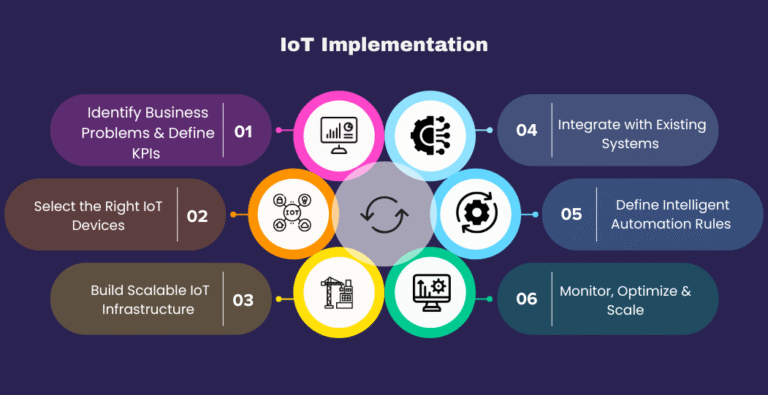
Successfully implementing IoT automation requires a structured, business-focused approach.
Step 1: Identify Business Problems & Define KPIs
Start with business outcomes, not devices.
Examples:
- Reduce energy costs by 20%
- Eliminate manual attendance tracking
- Reduce machine downtime by 30%
Step 2: Select the Right IoT Devices
Choose devices based on your specific use case:
- IP cameras
- Smart sensors
- GPS trackers
- RFID systems
- Smart meters
Avoid overcomplicating the initial deployment.
Step 3: Build Scalable IoT Infrastructure
A strong enterprise IoT architecture should include:
- Cloud infrastructure
- Real-time analytics
- Data pipelines
- Scalable storage
- Security frameworks
Platforms like AWS IoT and Azure IoT Hub are commonly used.
Step 4: Integrate with Existing Systems
IoT automation becomes significantly more powerful when integrated with:
- ERP platforms
- HR systems
- CRM software
- Payroll tools
- Business workflow systems
Step 5: Define Intelligent Automation Rules
Examples:
- If temperature exceeds threshold → notify maintenance
- If unauthorized access detected → trigger security alert
- If occupancy drops → reduce HVAC usage
This is where IoT data turns into business action.
Step 6: Monitor, Optimize & Scale
IoT implementation is an ongoing optimization process.
Track:
- Performance metrics
- Operational savings
- Workflow efficiency
- ROI improvements
Then scale gradually across departments and locations.
Key Challenges in IoT Implementation — and Solutions
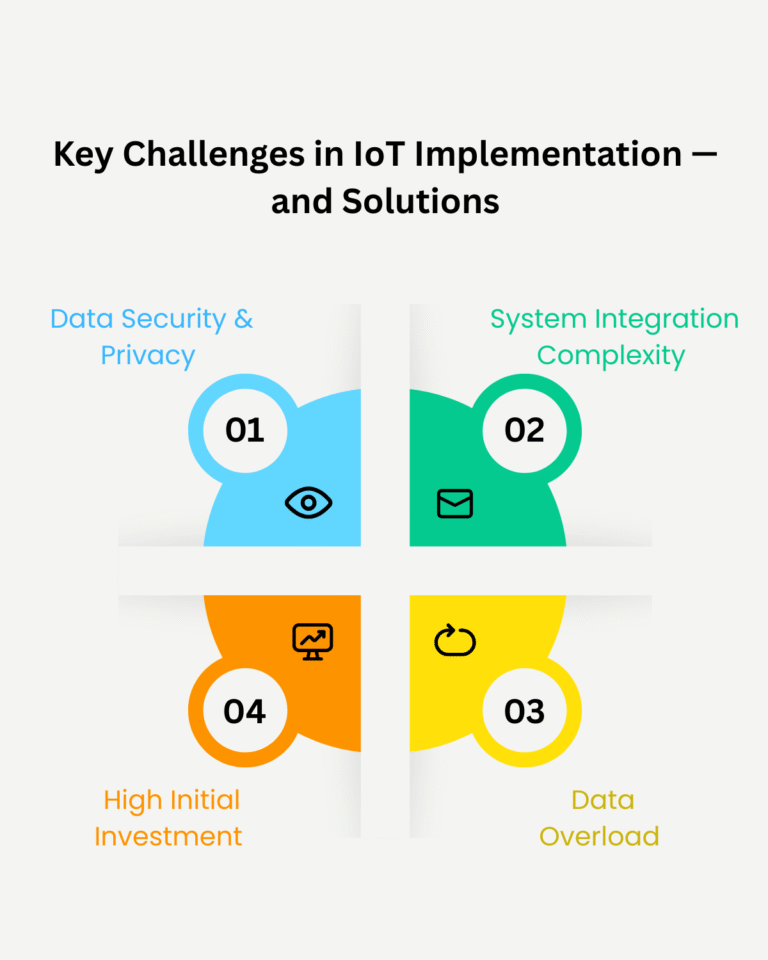
1. Data Security & Privacy
Challenge
Connected devices increase cybersecurity risks.
Solution
- End-to-end encryption
- Device authentication
- Network segmentation
- Regular firmware updates
- ISO-standard security practices
2. System Integration Complexity
Challenge
Integrating IoT with legacy systems can be difficult.
Solution
Use API-first platforms and experienced integration partners like Codeflix.
3. High Initial Investment
Challenge
Hardware and deployment costs can seem high initially.
Solution
Start with a focused pilot project, measure ROI, then scale strategically.
4. Data Overload
Challenge
IoT systems generate massive amounts of data.
Solution
Focus dashboards on actionable KPIs and use AI-powered analytics to filter noise.
Why Businesses Choose Codeflix for IoT Automation Solutions
Codeflix delivers end-to-end IoT automation solutions designed around real operational challenges — not generic device deployments.
What We Offer
- Custom IoT solution development
- Enterprise IoT implementation
- AI-powered analytics dashboards
- Workflow automation systems
- Smart surveillance integration
- CRM, ERP, HR, and payroll integration
- Ongoing optimization support
What Makes Codeflix Different
- Business-first implementation approach
- Scalable architecture from pilot to enterprise
- Real-world deployment experience
- Integration of IoT with AI and analytics
- ROI-focused delivery model
The Future of IoT in Business Automation
Several emerging technologies will shape the future of IoT-driven business automation.
AIoT (Artificial Intelligence of Things)
AI-powered IoT systems will make autonomous operational decisions without human intervention.
Edge Computing
Processing data closer to devices reduces latency and enables real-time responses.
Digital Twins
Virtual replicas of physical systems will help businesses simulate operations and predict failures.
Hyper automation
The combination of IoT, AI, and RPA will create fully autonomous workflows.
5G-Enabled IoT
5G networks will support:
- More connected devices
- Faster communication
- Near-zero latency
- Smarter industrial automation
Businesses investing in IoT capabilities today will be positioned to adopt these innovations faster.
Conclusion
IoT is no longer an experimental technology — it is a proven business transformation enabler.
From predictive maintenance and smart surveillance to workforce automation and intelligent energy management, IoT in business automation is helping enterprises reduce costs, improve operational visibility, and automate critical workflows at scale.
However, successful implementation requires more than deploying devices. Businesses need the right strategy, scalable architecture, integration expertise, and long-term optimization capabilities.
Whether you’re planning to automate workforce management, implement predictive maintenance, optimize energy consumption, or deploy enterprise IoT solutions, Codeflix can help you design, implement, and scale an IoT automation strategy tailored to your business goals.
Ready to Transform Your Business with IoT?
Want to identify high-ROI IoT opportunities in your business?
Schedule a free consultation with the Codeflix team and discover how IoT automation can improve efficiency, reduce operational costs, and create intelligent business workflows tailored to your organization.
Get in touch with Codeflix today!
FAQ
What is IoT in business automation?
IoT in business automation refers to using connected devices, sensors, and smart systems to collect real-time data and automate business workflows without manual intervention.
How does IoT improve operational efficiency?
IoT improves efficiency by enabling real-time monitoring, predictive maintenance, automated workflows, and intelligent decision-making.
What industries benefit most from IoT automation?
Manufacturing, logistics, healthcare, retail, smart buildings, and enterprise workplaces benefit significantly from IoT automation.
What are the major challenges in IoT implementation?
The biggest challenges include security risks, system integration complexity, infrastructure costs, and managing large data volumes.
What is AIoT?
AIoT (Artificial Intelligence of Things) combines IoT devices with AI-powered analytics to create intelligent, self-optimizing systems.