
As industries move towards digital transformation, Industrial IoT (IIoT) is emerging as a major force in today’s infrastructure game. By connecting machines, sensors, software, and people, Industrial IoT is not only improving productivity but also changing the way the entire sector functions.
In this blog, we will discuss the major concepts of Industrial IoT, the devices involved, their benefits, applications, and how it’s changing industries like automation, telecom, and oil & gas.
What is Industrial IoT?
Bringing IOT Technology to the industrial world is termed Industrial IOT, for instance, consider manufacturing units, power generation plants, transportation systems, and more. It acts as a connector between physical devices, like sensors and machinery, and digital platforms that store and analyze data in real-time.
When we talk about IOT, there is a big difference between consumer IOT and Industrial IOT. Consumer IoT is all about making our lives more comfortable think smart homes, and Industrial IoT, which is generally focused on improving operational efficiency, enhancing safety features, and supporting predictive maintenance. This technology allows industries to:
- Monitor their equipment remotely
- Automate their usual tasks.
- Helpful in minimizing unexpected downtime.
- Streamline production processes.
To summarize, Industrial IoT creates smarter, more responsive industrial ecosystems that evolve in real time.

What are Industrial IoT Devices?
The primary concept of Industrial IOT lies in its connected devices that collect and share data across various systems. In the market, widely used Industrial IoT devices include:
- Sensors: These are designed to measure various physical variables such as temperature, pressure, vibration, or humidity.
- Actuators: Based on the input from the sensor. They perform several actions, such as opening a valve or switching something off.
- Edge Devices/Gateways: Before sending to cloud platforms, it will process data locally, which helps reduce latency.
- Programmable Logic Controllers: Tough industrial computers designed specifically for automation and real-time control
- Connected Machines: Think of equipment such as robotic arms, CNC machines, or HVAC systems that come with embedded IoT capabilities.
- RFID and Barcode Readers: They help to track the assets in real-time, whether you’re handling a supply chain or organizing a warehouse.
These devices collaborate to form an ecosystem where data flows effortlessly from physical operations to digital decision-makers.
What are the Key Benefits of Industrial IoT?
Industrial IOT offers various benefits, making it a solid investment for businesses aiming to modernize. Key benefits include:
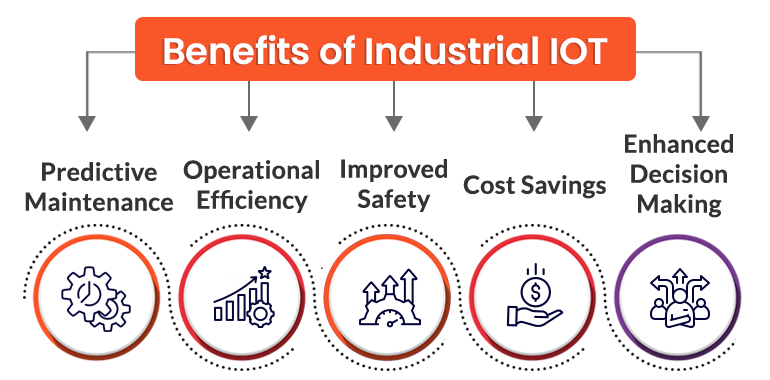
- Predictive Maintenance: IIOT permits real-time tracking of how equipment is functioning. Instead of performing a strict maintenance schedule, organizations can get in and take action when they notice any signs of wear and tear. This method helps reduce downtime and keep repair costs in control.
- Operational Efficiency: Automated data collection and process optimization play an important role in reducing manual errors, hurrying up operations, and improving productivity on production lines.
- Improved Safety: Sensors are developed to find out dangerous situations such as gas leaks or severe temperatures.
- Cost Savings: IIoT minimizes waste, makes energy use more efficient, and reduces equipment failure, all of which lead to significant cost reductions during the period of time.
- Enhanced Decision-Making: Data-driven insights provide well-informed strategic planning, whether in procurement, logistics, or production.
Overall, the benefits of Industrial IoT lead to increased Operational excellence and adaptability in Unpredictable market conditions.
Industrial IoT Applications
Industrial IoT is not limited to one particular sector; it’s changing how various other industries function by creating smarter, more connected systems. Some significant applications of Industrial IoT include:
- Smart Manufacturing: There are a lot of features that help smart manufacturing, such as real-time quality control, autonomous machinery, and predictive analytics. These are driving Industry 4.0.
- Energy Management: Utilities use IIoT to monitor power grids, improve energy efficiency, and minimize outages.
- Logistics & Supply Chain: IIoT allows real-time tracking of goods, optimizing routes, and streamlining warehouse automation.
- Agriculture: Smart farming tools monitor soil health, weather conditions, and livestock, boosting yield and promoting sustainability.
- Smart Cities: IoT-based infrastructure, such as traffic control systems, waste management, and public safety monitoring.
All the above-mentioned applications improve transparency, efficiency, and responsiveness. Among the respective sectors.
IoT Industrial Automation
- Machine-to-Machine (M2M) Communication
- Remote Monitoring and Diagnostics
- Real-Time Control Systems
- AI-Driven Quality Control
IoT in the Telecom Industry
The telecom sector plays a double role as an enabler and beneficiary. In the industrial IoT ecosystem.
How Telecom Enables IIoT:
- 5G Networks: Ultra-low latency and high bandwidth are necessary for supporting real-time IIoT applications. Allowing for the local processing of data at its source
- Edge Computing Infrastructure: Edge computing has become a major focus for telecom companies who are seeking to expand their infrastructure presence. As a result, decisions are made more quickly and data is transferred more efficiently across systems.
- SIM and eSIM Technology: This will ensure secure connections for industrial IoT devices that are set up in remote or mobile locations.
How IIoT Benefits Telecom:
- Network Optimization: IoT sensors play an important role for telecom operators by allowing them to monitor infrastructure, detect outages, and optimize performance.
- Smart Towers and Base Stations: Automated systems will take care of cooling, power management, and threat detection.
- Customer Experience: In terms of customer experience, the data collected through IOT will be helpful for telecom companies to personalize their services and predict the customer requirements and what they will expect next.
With the help of industrial IoT, the telecom industry can provide more reliable services while improving its internal operations.
IoT in the Oil and Gas Industry:
The oil and gas industry faces some tough challenges, such as remote operations, bad environmental conditions, and strict safety regulations. Here comes Industrial IoT plays an important role in fixing these challenges through:
- Remote Monitoring and Control: IIoT allows operators to check offshore rigs and pipelines in real-time, which cuts down the need for manual on-site personnel.
- Predictive Equipment Maintenance: IIoT gathers data based on equipment performance, and based on that, it helps to predict and prevent critical failures in compressors, pumps, and drilling systems.
- Leak Detection and Safety: Smart sensors are designed to quickly detect gas leaks or any unusual pressure levels, triggering emergency protocols and limiting environmental risks.
- Asset Tracking: RFID and GPS-enabled devices support tracking tools, vehicles, and supplies, and improve operations to run more smoothly.
- Energy Optimization: IIoT systems check fuel consumption and improve power usage across drilling and refining operations.
With the help of IToT integration, oil and gas companies boost uptime, and enhance safety and sustainability, all while reducing operational costs involved.
Conclusion
The boom of Industrial IoT plays a key role in changing how industries function, optimize, and grow. By using advancements like predictive maintenance, automation, and real-time monitoring, IIoT is delivering measurable improvements across various sectors.
The benefits of Industrial IoT are not limited to cost savings. They enable businesses to become more resilient, efficient, and future-ready. As industries continue to evolve, companies that adopt IIoT will be well-positioned to lead in their respective markets.
At Codeflix, we’re all about delivering smart, scalable IoT solutions, including Industrial IoT applications that are personalized to fit your industry’s unique needs. Whether you’re in manufacturing, telecom, or energy, we’re here to support you in tapping into the full potential of connected intelligence.