
Introduction
Businesses today operate in an environment where customer expectations are constantly evolving, competition is increasing, and technology continues to reshape industries. Customers expect faster service, personalized experiences, and seamless interactions across every touchpoint. At the same time, organizations must manage growing amounts of data, improve operational efficiency, and adapt quickly to changing market conditions. Relying on manual processes and disconnected systems can make these challenges even more difficult to overcome.
Digital transformation helps businesses modernize the way they operate by adopting technologies that improve productivity, simplify workflows, and support better decision-making. However, digital transformation is about more than simply purchasing new software or upgrading existing systems. It involves rethinking business processes, improving collaboration between teams, and using technology to create better experiences for both employees and customers.
Every business has unique goals, operational challenges, and growth plans. That’s why choosing the right digital transformation solutions is essential for achieving long-term success. The right combination of technologies can help organizations streamline operations, improve visibility, reduce manual work, and respond more effectively to changing business needs.
In this guide, you’ll learn what digital transformation solutions are, why they are important for modern businesses, the technologies that support digital transformation, their key benefits, common implementation challenges, and practical steps for building a successful digital transformation strategy.
What Are Digital Transformation Solutions?
Digital transformation solutions are technologies and strategies that help businesses improve operations, automate processes, enhance customer experiences, and make better decisions through digital tools such as Customer Relationship Management (CRM), workflow automation, Artificial Intelligence (AI), Business Intelligence (BI), Internet of Things (IoT), cloud platforms, and data analytics.
Rather than focusing on a single department or business function, these solutions work together to improve how an organization operates as a whole. They replace manual, time-consuming processes with efficient digital workflows, provide real-time access to business information, and enable teams to collaborate more effectively.
Businesses invest in digital transformation for many reasons. Some want to improve operational efficiency, while others aim to enhance customer service, reduce costs, or gain better insights from their data. As organizations grow, managing operations through spreadsheets, paper-based processes, or disconnected applications becomes increasingly difficult. Digital transformation provides a structured approach to overcoming these challenges while supporting future growth.
Unlike traditional business improvement initiatives, which often focus on solving individual problems, digital transformation takes a broader perspective. It considers how people, processes, and technology can work together to create a more connected and efficient business environment.
Technology alone cannot drive successful transformation. Employees must be equipped with the right tools and training, business processes should be optimized before they are automated, and different systems need to communicate seamlessly with one another. When these elements work together, businesses can operate more efficiently, make faster decisions, and deliver greater value to their customers.
Why Digital Transformation Is Important for Modern Businesses
Organizations that embrace digital transformation are better prepared to adapt to changing customer expectations, market trends, and business challenges. By combining the right technologies with well-designed processes, businesses can improve efficiency, strengthen collaboration, and build a foundation for sustainable growth.
Improve Operational Efficiency
Many organizations still rely on repetitive manual tasks that consume valuable time and increase the risk of errors. Activities such as processing approvals, updating customer records, generating reports, and managing internal requests often require unnecessary administrative effort.
Digital transformation streamlines these activities by automating routine processes, reducing manual intervention, and ensuring tasks move through standardized workflows. Employees spend less time handling repetitive work and more time focusing on activities that contribute to business growth and innovation.
Deliver Better Customer Experiences
Customer expectations continue to evolve as digital services become more accessible. Businesses are expected to provide quick responses, personalized interactions, and consistent service across multiple communication channels.
Digital transformation enables organizations to understand customer needs more effectively by centralizing information, improving communication, and providing faster access to relevant data. Whether responding to customer enquiries, managing support requests, or tracking sales opportunities, digital solutions help create smoother and more satisfying customer experiences.
Support Data-Driven Decision Making
Modern businesses generate large volumes of data every day. However, data only becomes valuable when it can be transformed into meaningful insights.
Digital transformation solutions provide access to real-time dashboards, reports, and analytics that help decision-makers monitor performance, identify trends, and respond to changing business conditions. Instead of relying on assumptions or outdated information, leaders can make informed decisions based on accurate and up-to-date business data.
Increase Business Agility
Business environments can change rapidly due to market demands, customer preferences, or industry developments. Organizations that rely on rigid processes often struggle to respond quickly to these changes.
Digital transformation improves business agility by enabling organizations to adapt workflows, introduce new services, and implement operational changes more efficiently. Flexible digital systems allow businesses to respond faster to new opportunities while maintaining consistency across departments.
Stay Competitive in a Digital Economy
Technology has become a key factor in how businesses compete. Organizations that continue to depend on outdated systems or manual processes may find it difficult to keep pace with competitors that have adopted modern digital solutions.
Digital transformation helps businesses remain competitive by improving efficiency, strengthening customer relationships, and enabling continuous improvement. As technology continues to evolve, organizations that invest in digital transformation are better positioned to meet future challenges, embrace innovation, and support long-term business growth.
Core Technologies Used in Digital Transformation
A single technology does not drive digital transformation. Instead, it brings together multiple digital solutions that work as a connected ecosystem to improve business performance. Each technology addresses specific business challenges, and when integrated effectively, they help organizations streamline operations, improve customer experiences, and make informed decisions.
Let’s explore the core technologies that underpin a successful digital transformation strategy.
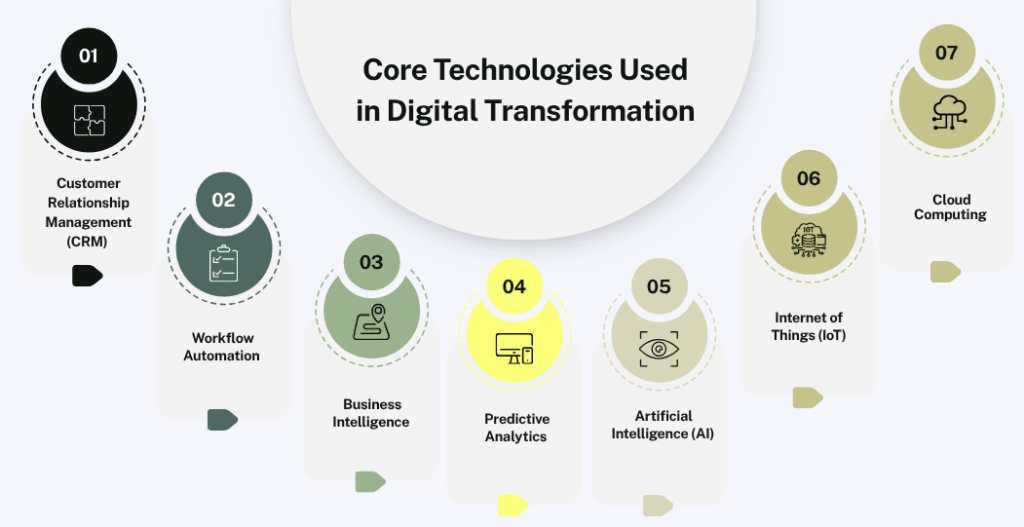
Customer Relationship Management (CRM)
Building strong customer relationships is essential for business growth, but managing customer information through spreadsheets or disconnected systems often leads to missed opportunities and inconsistent communication. A Customer Relationship Management (CRM) system helps businesses centralize customer data and manage every stage of the customer journey from one platform.
With CRM software, sales teams can track leads, monitor sales opportunities, schedule follow-ups, and maintain complete customer interaction histories. Marketing teams can better understand customer preferences, while customer support teams can access relevant information to provide faster and more personalized assistance.
Having all customer information in one place improves collaboration between departments and ensures everyone is working with accurate, up-to-date data. This leads to stronger customer relationships, better sales management, and improved customer satisfaction.
Internal Link Opportunity: Importance of CRM: Benefits for Business Growth
Workflow Automation
Many organizations spend considerable time handling repetitive administrative tasks such as approvals, document routing, task assignments, and internal requests. As businesses grow, managing these activities manually becomes increasingly inefficient.
Workflow automation helps businesses streamline these routine processes by automatically moving tasks through predefined workflows. Instead of relying on manual emails or follow-up reminders, the system automatically assigns responsibilities, sends notifications, and tracks progress until each task is completed.
For example, employee onboarding, purchase approvals, invoice processing, and leave management can all be automated to reduce delays and improve consistency. Employees spend less time on repetitive work, while managers gain greater visibility into business operations.
Workflow automation not only improves productivity but also reduces manual errors and ensures processes follow standardized business rules across departments.
Internal Link Opportunity: Workflow Automation Software: Features, Benefits & How to Choose the Right Solution
Business Intelligence
Every business generates valuable data, but data alone does not support better decision-making. Business Intelligence (BI) transforms raw information into meaningful insights through interactive dashboards, reports, and visual analytics.
Rather than reviewing multiple spreadsheets or manually preparing reports, decision-makers can access real-time information that highlights business performance, sales trends, operational metrics, and key performance indicators (KPIs).
Business Intelligence allows organizations to identify opportunities, detect operational bottlenecks, monitor departmental performance, and measure progress toward business objectives. Clear data visualization makes complex information easier to understand, helping managers make faster and more confident decisions.
When reliable information is available in real time, businesses can respond more effectively to changing market conditions and customer demands.
Internal Link Opportunity: Business Intelligence Dashboard Best Practices Guide
Predictive Analytics
While Business Intelligence focuses on understanding current and historical data, Predictive Analytics helps businesses prepare for what may happen next.
By analyzing historical patterns and trends, predictive analytics can forecast future outcomes, identify potential risks, estimate customer demand, and support more informed planning. Businesses can use these insights to improve inventory management, optimize resource allocation, anticipate customer behavior, and reduce operational risks.
For example, a retail business can forecast seasonal demand, while a service organization can identify customers who may require additional support or are likely to purchase additional services.
Rather than reacting to problems after they occur, predictive analytics enables organizations to make proactive decisions that improve business performance and reduce uncertainty.
Internal Link Opportunity: Predictive Analytics Software: Features, Benefits & How to Choose the Right Solution
Artificial Intelligence (AI)
Artificial Intelligence has become an important part of digital transformation because it helps businesses automate complex tasks, improve customer interactions, and increase operational efficiency.
One of the most common applications of AI is the use of intelligent chatbots that can answer frequently asked questions, guide customers to the appropriate department, schedule appointments, or collect information before transferring conversations to support teams.
Beyond customer service, AI can assist with document processing, recommend products or services based on customer preferences, analyze business data, and automate repetitive decision-making processes.
By handling routine activities and supporting employees with intelligent recommendations, AI enables businesses to improve productivity while delivering faster and more consistent customer experiences.
Internal Link Opportunity: AI Chatbot for Business
Internet of Things (IoT)
The Internet of Things (IoT) connects physical devices, equipment, and sensors to collect and share real-time information. This allows businesses to monitor assets, track performance, and respond more quickly to operational issues.
In manufacturing, IoT sensors can monitor machine performance and identify signs of equipment failure before breakdowns occur. Logistics companies can track vehicle locations and monitor delivery conditions, while facility managers can monitor energy usage and building systems remotely.
Real-time data collected from connected devices helps businesses improve operational efficiency, reduce downtime, and make faster decisions based on actual performance rather than assumptions.
When combined with other digital technologies, IoT provides greater visibility across business operations and supports more proactive management.
Internal Link Opportunity: IoT in Business Automation
Cloud Computing
Cloud computing has changed how businesses store, access, and manage information. Rather than depending entirely on on-premises systems, organizations can access applications, data, and services through the cloud from any location with an internet connection.
It supports teamwork by making it easier for employees to share information and work together across different locations. This is especially useful for businesses with remote or hybrid work models.
Cloud computing also offers flexibility as business needs change. Companies can scale storage, users, and applications without investing heavily in new infrastructure. Features such as automatic updates, data backups, and disaster recovery help keep systems reliable and available.
By providing secure, flexible, and scalable access to business resources, cloud computing plays a key role in modern digital transformation efforts.
Why These Technologies Work Better Together
Although each technology delivers value on its own, the greatest business benefits come when they are integrated into a connected digital ecosystem.
For example, a CRM system can automatically share customer information with workflow automation software to assign sales opportunities and initiate follow-up activities. Business Intelligence dashboards can combine data from CRM, finance, and operational systems to provide a complete view of business performance. Predictive Analytics can analyze this data to forecast trends, while AI helps automate customer interactions and IoT devices provide real-time operational insights.
When these technologies communicate with one another, businesses eliminate information silos, reduce manual work, improve collaboration, and gain a comprehensive view of their operations. This integrated approach enables organizations to make faster decisions, improve efficiency, and build a stronger foundation for long-term digital transformation.
Key Benefits of Digital Transformation Solutions
Digital transformation is not simply about adopting new technologies. Its real value lies in improving the way a business operates, serves customers, and adapts to changing market demands. When implemented with clear business objectives, digital transformation solutions help organizations become more efficient, productive, and prepared for future growth.
Below are some of the key benefits businesses can expect from a successful digital transformation strategy.
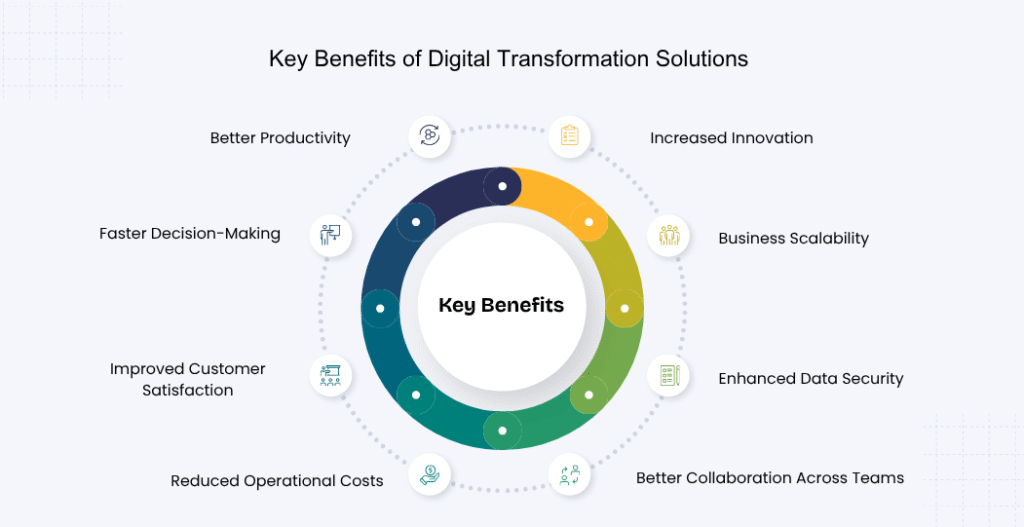
Better Productivity
Manual tasks often consume valuable time and limit employee productivity. Activities such as entering data, managing approvals, preparing reports, or following up on requests can reduce the time employees spend on meaningful work.
Digital transformation solutions automate repetitive processes and simplify day-to-day operations. Employees no longer need to perform the same administrative tasks repeatedly, allowing them to focus on problem-solving, customer engagement, and strategic initiatives.
By reducing manual effort and streamlining workflows, businesses can accomplish more without increasing operational complexity.
Faster Decision-Making
Business decisions are most effective when they are supported by accurate and up-to-date information. However, organizations using disconnected systems often struggle to access reliable data quickly.
Digital transformation brings information together from different departments and presents it through dashboards, reports, and analytics. Business leaders can monitor key performance indicators, identify emerging trends, and respond to challenges using real-time insights.
Instead of waiting for manual reports or relying on assumptions, decision-makers gain immediate access to the information they need to act with confidence.
Improved Customer Satisfaction
Customer expectations continue to rise, and businesses must deliver fast, consistent, and personalized experiences to remain competitive.
Digital transformation helps organizations improve customer interactions by providing employees with complete customer information, automating routine responses, and ensuring enquiries are handled efficiently. Whether managing sales enquiries, support requests, or service delivery, digital solutions reduce delays and improve communication.
When customers receive quicker responses and better service, satisfaction increases, leading to stronger relationships and improved customer loyalty.
Reduced Operational Costs
Inefficient processes often result in unnecessary operational expenses. Manual paperwork, repetitive administrative tasks, delayed approvals, and duplicated work all contribute to higher costs.
Digital transformation reduces these inefficiencies by automating business processes, improving resource utilization, and minimizing manual errors. Organizations can complete more work with existing resources while reducing the costs associated with paper-based processes, repetitive tasks, and process delays.
Rather than simply cutting expenses, digital transformation enables businesses to invest their resources more effectively.
Better Collaboration Across Teams
Departments often work with different systems and isolated information, making collaboration more challenging. Miscommunication and duplicated efforts can slow business operations and reduce overall efficiency.
Digital transformation connects people, processes, and systems through integrated digital platforms. Employees can access shared information, monitor workflow progress, and collaborate more effectively regardless of their department or location.
Improved communication creates greater transparency, reduces misunderstandings, and helps teams work toward common business goals.
Enhanced Data Security
As businesses increasingly rely on digital information, protecting sensitive data becomes more important than ever.
Modern digital transformation solutions include security features such as user authentication, role-based access control, encrypted data storage, automated backups, and activity tracking. These capabilities help organizations safeguard customer information, financial records, and business-critical data while reducing the risk of unauthorized access.
A secure digital environment also supports regulatory compliance and strengthens customer confidence.
Business Scalability
Business growth often brings new challenges, including larger customer bases, additional employees, increased operational demands, and more complex workflows.
Digital transformation provides scalable solutions that can grow alongside the business. Organizations can expand users, automate additional processes, integrate new systems, and manage increasing workloads without significantly disrupting existing operations.
Scalable technology ensures businesses remain agile and prepared for future expansion.
Increased Innovation
Organizations that embrace digital transformation create an environment where innovation becomes part of everyday operations.
By reducing manual work and improving access to information, employees have more time to identify process improvements, develop new services, and respond to changing customer needs. Digital platforms also provide valuable insights that support continuous improvement and encourage organizations to explore new business opportunities.
Innovation becomes easier when businesses have the right technology foundation to support change.
Common Challenges During Digital Transformation
While digital transformation offers significant business benefits, successful implementation requires careful planning. Many organizations encounter challenges that can delay progress if left unaddressed early. Understanding these challenges allows businesses to prepare effective strategies and improve the likelihood of a successful transformation.
Resistance to Change
Employees are often comfortable with familiar processes and may hesitate to adopt new technologies or ways of working.
Without proper communication and involvement, resistance to change can slow implementation and reduce user adoption. Businesses should clearly explain the purpose of digital transformation, demonstrate its benefits, and encourage employee participation throughout the transition.
When employees understand how new systems improve their daily work, they are more likely to embrace change.
Legacy Systems
Many organizations continue to rely on outdated software or infrastructure that no longer meets current business requirements.
Older systems may lack integration capabilities, limit automation opportunities, or create barriers to accessing accurate information. Replacing or modernizing these systems requires careful planning to avoid disrupting ongoing business operations.
A phased implementation approach often helps businesses transition more smoothly while minimizing operational risks.
Data Integration Challenges
Business information is frequently stored across multiple applications, departments, or databases. Integrating these systems can be one of the most complex aspects of digital transformation.
Without proper integration, organizations may continue to experience duplicate data, inconsistent reporting, and disconnected workflows.
Choosing technologies that support seamless integration helps businesses create a unified digital environment where information flows efficiently across systems.
Budget Constraints
Digital transformation is a long-term investment that requires financial planning.
Some organizations attempt to implement too many technologies at once, resulting in higher costs and increased complexity. Others delay important initiatives because they focus only on short-term expenses rather than long-term business value.
Prioritizing high-impact projects and implementing transformation in stages helps organizations manage budgets more effectively while delivering measurable results.
Employee Training
Introducing new technologies without proper training often results in low adoption rates and reduced productivity.
Employees need practical guidance to understand how digital solutions fit into their daily responsibilities. Training programs, user documentation, and ongoing support help teams build confidence and maximize the value of new systems.
Successful digital transformation depends as much on people as it does on technology.
Cybersecurity Concerns
As businesses adopt more digital platforms and cloud-based services, protecting business information becomes increasingly important.
Organizations must implement appropriate security measures, including access controls, encryption, regular software updates, and employee awareness programs. A proactive approach to cybersecurity helps protect sensitive data while reducing potential business risks.
Security should be considered from the beginning of every digital transformation initiative rather than being treated as an afterthought.
Choosing the Right Technology
The market offers a wide range of digital solutions, making it difficult for businesses to identify the best fit for their requirements.
Selecting technology based solely on popularity or cost may not deliver the desired results. Businesses should evaluate solutions based on their operational goals, scalability, integration capabilities, ease of use, and long-term business value.
Choosing the right combination of technologies creates a stronger foundation for sustainable digital transformation
How to Successfully Implement Digital Transformation Solutions
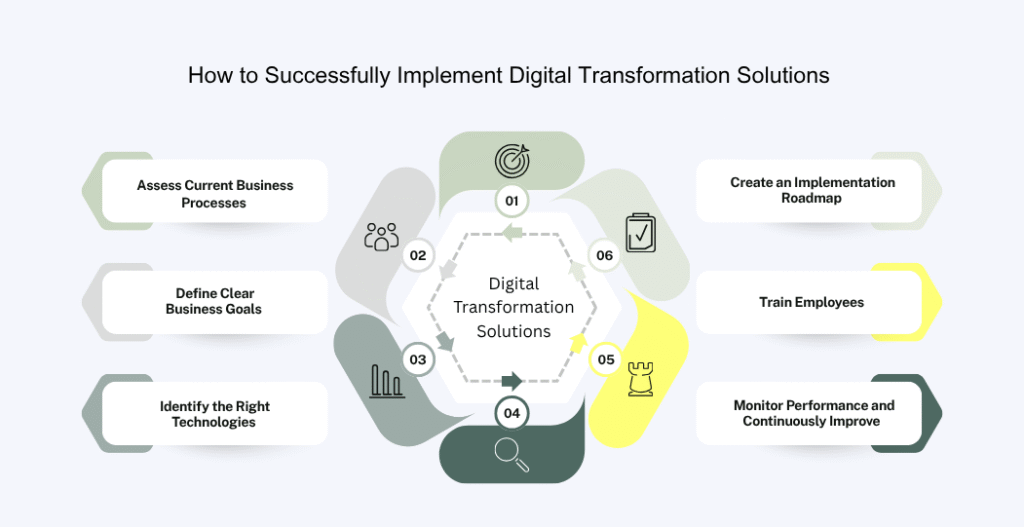
A successful digital transformation strategy requires more than investing in new technology. It involves understanding business objectives, selecting the right solutions, and continuously improving processes over time.
The following step-by-step approach can help organizations implement digital transformation more effectively.
Step 1: Assess Current Business Processes
Begin by reviewing how your business currently operates.
Identify manual tasks, repetitive activities, communication gaps, approval delays, and operational bottlenecks that affect productivity. Understanding existing challenges helps determine where digital transformation will deliver the greatest value.
This assessment provides a clear starting point for improvement.
Step 2: Define Clear Business Goals
Every digital transformation initiative should support specific business objectives.
Whether the goal is improving customer service, reducing operational costs, increasing productivity, or enhancing decision-making, clearly defined objectives help guide technology selection and measure success.
Well-defined goals also ensure that digital transformation remains aligned with overall business strategy.
Step 3: Identify the Right Technologies
Choose technologies that directly support your business requirements instead of adopting every available digital solution.
Depending on your objectives, this may include:
- Customer Relationship Management (CRM) for managing customer interactions and sales activities.
- Workflow Automation to streamline repetitive processes and approvals.
- Business Intelligence for real-time dashboards and business reporting.
- Predictive Analytics to forecast trends and support better planning.
- Artificial Intelligence (AI) for intelligent automation and customer engagement.
- Internet of Things (IoT) for connected devices and real-time operational monitoring.
Selecting technologies that integrate effectively with existing systems creates a stronger digital foundation.
Step 4: Create an Implementation Roadmap
Digital transformation should be introduced through a structured implementation plan rather than attempting to change everything simultaneously.
Develop a roadmap that outlines project phases, timelines, responsibilities, milestones, and expected outcomes. Prioritize initiatives based on business impact and available resources.
A phased approach reduces implementation risks while allowing teams to adapt gradually.
Step 5: Train Employees
Technology delivers results only when employees understand how to use it effectively.
Provide training sessions, practical demonstrations, user guides, and ongoing support to help employees become comfortable with new systems. Encourage feedback and address concerns throughout the implementation process.
Well-trained employees contribute significantly to the success of digital transformation initiatives.
Step 6: Monitor Performance and Continuously Improve
Digital transformation is an ongoing process rather than a one-time project.
Regularly review performance metrics, user feedback, workflow efficiency, and business outcomes to identify opportunities for improvement. As business requirements evolve, update workflows, integrate additional technologies, and refine processes to achieve even greater efficiency.
Continuous improvement ensures that digital transformation continues delivering value as the organization grows.
Expert Insight: Digital Transformation Delivers Better Results When Technologies Work Together
Many businesses begin their digital transformation journey by implementing a single software solution to address a specific challenge. While this approach can deliver immediate improvements, organizations often discover that disconnected systems create new obstacles. Information becomes scattered across multiple platforms, employees switch between different applications, and manual data entry continues to consume valuable time.
The greatest value of digital transformation comes from integrating technologies so they work as one connected ecosystem. For example, a CRM system can automatically trigger workflow automation to assign sales opportunities and schedule follow-ups. Business Intelligence dashboards can analyze data collected from multiple systems, while Predictive Analytics helps forecast future trends using that information. AI-powered chatbots can handle customer enquiries and automatically create support tickets, while IoT devices provide real-time operational data that supports predictive maintenance and performance monitoring.
At Codeflix, we help businesses implement digital transformation solutions that integrate with their existing systems rather than replacing everything at once. By combining technologies such as CRM, Workflow Automation, Business Intelligence, Predictive Analytics, AI, IoT, and Helpdesk solutions, we help organizations simplify operations, improve visibility, increase productivity, and build a scalable technology foundation that supports long-term business growth
Conclusion
Digital transformation is not a one-time project but a continuous journey of improving how a business operates, serves customers, and adapts to changing market demands. Organizations that embrace digital transformation are better equipped to streamline operations, improve collaboration, make informed decisions, and deliver exceptional customer experiences.
The success of any digital transformation initiative depends on selecting technologies that align with business objectives and integrating them into a connected ecosystem. Solutions such as CRM, workflow automation, business intelligence, predictive analytics, artificial intelligence, IoT, and cloud technologies work best when they support one another rather than operating independently.
Instead of attempting to transform every aspect of the business at once, organizations should begin with clearly defined goals, prioritize high-impact initiatives, and continuously evaluate their progress. A phased approach reduces implementation risks while creating a strong foundation for future growth.
As technology continues to evolve, businesses that invest in digital transformation today will be better positioned to improve efficiency, respond to changing customer expectations, and remain competitive in an increasingly digital world.
Ready to Accelerate Your Digital Transformation?
At Codeflix, we help businesses implement digital transformation solutions tailored to their unique goals and operational requirements. Whether you’re looking to strengthen customer relationships with CRM, streamline operations through Workflow Automation, gain actionable insights with Business Intelligence, improve planning using Predictive Analytics, enhance customer engagement with AI-powered Chatbots, connect assets through IoT, or optimize support services with Helpdesk Solutions, our team delivers integrated technology solutions designed for long-term success.
If you’re ready to simplify business processes, improve operational efficiency, and build a scalable digital foundation, Codeflix is here to help you take the next step in your digital transformation journey
FAQ
What are digital transformation solutions?
Digital transformation solutions are technologies and strategies that help businesses modernize their operations by improving processes, automating repetitive tasks, enhancing customer experiences, and supporting data-driven decision-making. These solutions often include CRM, Workflow Automation, Business Intelligence, Predictive Analytics, Artificial Intelligence, IoT, Cloud Technologies, and Helpdesk systems.
Why is digital transformation important?
Digital transformation enables businesses to improve operational efficiency, respond more quickly to customer needs, reduce manual work, and make better business decisions using real-time data. It also helps organizations remain competitive in an increasingly digital business environment.
What technologies are used in digital transformation?
Digital transformation typically combines several technologies, including Customer Relationship Management (CRM), Workflow Automation, Business Intelligence (BI), Predictive Analytics, Artificial Intelligence (AI), Internet of Things (IoT), Cloud Computing, Helpdesk Solutions, and data integration platforms. The right combination depends on each organization's goals and operational requirements.
How does CRM support digital transformation?
A CRM system centralizes customer information, tracks sales opportunities, improves communication, and provides better visibility into customer interactions. This helps businesses strengthen customer relationships, improve sales performance, and deliver more personalized customer experiences.
What role does workflow automation play in digital transformation?
Workflow automation reduces manual work by automating repetitive business processes such as approvals, task assignments, document routing, and notifications. This improves efficiency, reduces errors, and ensures business processes are completed consistently.
Is Artificial Intelligence necessary for digital transformation?
Artificial intelligence is not mandatory for every digital transformation initiative, but it can significantly enhance business operations. AI supports intelligent automation, customer service through chatbots, predictive insights, document processing, and faster decision-making. Businesses can introduce AI gradually as their digital transformation strategy evolves.
How long does digital transformation take?
There is no fixed timeline because every organization has different objectives and operational requirements. Some projects may take a few months, while enterprise-wide digital transformation initiatives can continue over several years. Many businesses implement digital transformation in phases to minimize disruption and achieve measurable results at each stage.
What challenges do businesses face during digital transformation?
Common challenges include employee resistance to change, outdated legacy systems, data integration issues, limited budgets, insufficient training, cybersecurity concerns, and selecting technologies that align with long-term business goals. Careful planning and a structured implementation strategy help overcome these challenges.
Can small businesses implement digital transformation?
Yes. Digital transformation is beneficial for businesses of every size. Small businesses often begin by implementing solutions such as CRM, workflow automation, or cloud-based collaboration tools. As the business grows, additional technologies can be integrated to support changing operational requirements.
How do I choose the right digital transformation partner?
Choose a technology partner that understands your business objectives, industry challenges, and long-term growth plans. Look for experience in implementing integrated solutions, strong technical expertise, ongoing support, and the ability to customize solutions according to your business needs. A reliable partner should focus on delivering measurable business outcomes rather than simply deploying software.