
Introduction
Many businesses invest in CRM platforms expecting immediate improvements in sales, customer engagement, and operational efficiency. However, implementing a CRM system successfully is far more complex than simply purchasing software and onboarding employees.
According to industry research, nearly 30–70% of CRM implementation projects face adoption or operational challenges due to poor planning, low employee engagement, and ineffective workflow alignment. Despite increasing investments in CRM software, many businesses still struggle to achieve expected ROI because implementation strategies focus more on technology than business processes.
In 2026, companies are increasingly adopting CRM solutions to centralize customer data, automate workflows, improve lead management, and enhance customer experience. Yet, despite the growing adoption of CRM platforms, many organizations still face serious CRM implementation challenges that delay business outcomes and reduce ROI.
The biggest reason behind CRM implementation failure is not the software itself — it is poor planning, weak process alignment, low employee adoption, and improper integration strategies. Businesses often underestimate the operational impact of CRM deployment and focus only on technical setup rather than long-term usability.
At Codeflix Global Technologies, we help organizations implement scalable CRM systems designed around real business workflows, automation requirements, and operational efficiency goals. Instead of treating CRM as just a customer database, we focus on creating connected business ecosystems that support growth and digital transformation.
In this blog, we will explore the most common CRM implementation challenges, major mistakes businesses make during deployment, and practical CRM implementation best practices to ensure successful adoption in 2026.
Why CRM Implementation is More Challenging Than Businesses Expect
Many businesses initially assume CRM implementation is simply about purchasing software and training employees. However, once deployment begins, organizations often realize that CRM systems directly affect daily sales operations, customer communication workflows, reporting structures, and employee productivity.
A CRM system becomes part of everyday operations for sales teams, support departments, marketing teams, and management. If workflows are not planned correctly, the system can create confusion instead of improving productivity.
CRM implementation challenges usually arise because businesses:
- Rush deployment timelines
- Ignore workflow mapping
- Migrate poor-quality data
- Skip employee training
- Overcomplicate automation
- Fail to integrate existing systems properly
Without a structured implementation strategy, businesses often struggle with low adoption rates, inconsistent customer data, and operational inefficiencies.
Why Many CRM Implementations Fail
One of the biggest CRM implementation issues businesses face is the gap between expectations and execution.
Organizations often invest in advanced CRM platforms expecting immediate transformation without clearly understanding their operational requirements. As a result, teams struggle to adapt, workflows become complicated, and CRM usage gradually declines.
Some of the most common reasons CRM implementations fail include:
- Lack of business process analysis
- Poor project planning
- Choosing the wrong CRM platform
- Inadequate employee onboarding
- Weak change management strategies
- Poor CRM integration planning
- Lack of post-deployment optimization
Successful CRM implementation requires businesses to align technology, people, and processes together instead of focusing only on software features.
Top CRM Implementation Challenges Businesses Face in 2026
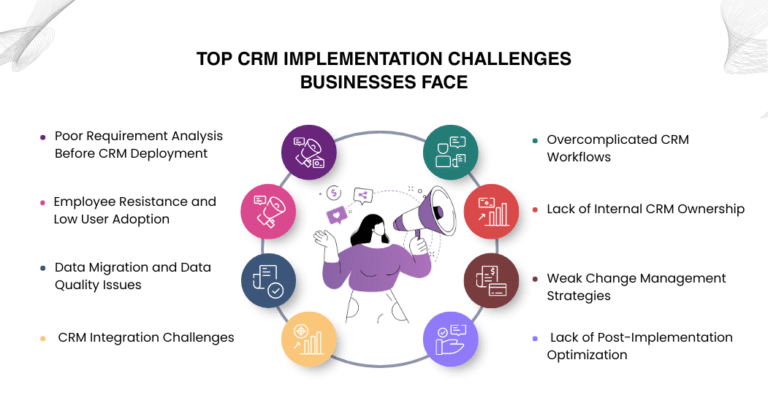
1. Poor Requirement Analysis Before CRM Deployment
One of the most common CRM implementation problems is selecting a CRM platform without a proper understanding of business workflows and operational needs.
Many organizations focus heavily on features and pricing but fail to analyze:
- Existing sales processes
- Customer support workflows
- Lead management requirements
- Reporting expectations
- Automation opportunities
This creates long-term operational issues after deployment.
Common Problems
- Incorrect workflow configuration
- Missing automation requirements
- Unnecessary CRM modules
- Process mismatches between departments
Solution
Before implementing CRM software, businesses should conduct detailed workflow analysis across all departments. Understanding operational challenges early helps create a CRM structure that supports actual business goals instead of forcing teams into rigid workflows.
At Codeflix Global Technologies, we start CRM implementation with an operational assessment and process mapping to ensure the platform aligns with your business objectives and scalability needs.
2. Employee Resistance and Low User Adoption
In many organizations, employees are already comfortable with existing tools like spreadsheets, email tracking, or manual follow-ups. When CRM systems introduce additional steps or complicated workflows, teams may resist using the platform consistently.
Employee resistance remains one of the biggest CRM implementation challenges in modern organizations.
Sales teams and support staff often resist adopting new CRM systems because they are comfortable using spreadsheets, emails, or manual tracking methods. Some employees also view CRM systems as monitoring tools rather than productivity solutions.
Without proper adoption strategies, businesses experience:
- Incomplete customer records
- Inconsistent CRM usage
- Low productivity
- Poor reporting accuracy
Studies show that user adoption remains one of the leading causes of CRM implementation failure. Even the most advanced CRM systems can become ineffective if employees are not properly trained or actively engaged during implementation.
Why User Adoption Fails
- Lack of training
- Complicated user interfaces
- Excessive manual data entry
- Poor communication during rollout
- No involvement from employees during implementation
Solution
Businesses should focus on simplifying workflows and involving employees during the implementation process. Proper onboarding, role-based training, and user-friendly automation significantly improve CRM adoption rates.
Successful CRM deployment depends on making the system helpful for employees instead of making it feel like an additional administrative burden.
3. Data Migration and Data Quality Issues
Data migration is one of the most technically challenging parts of CRM implementation.
Many businesses store customer information across spreadsheets, legacy systems, emails, and disconnected applications. Migrating this data into a centralized CRM platform often creates duplicate records, missing information, and inconsistent formatting.
Poor data quality can significantly impact CRM performance. In many organizations, customer information is spread across disconnected systems, making data migration one of the most technically sensitive stages of CRM implementation.
Common CRM Implementation Issues During Data Migration
- Duplicate customer profiles
- Missing contact information
- Inaccurate sales records
- Inconsistent lead sources
- Outdated customer history
Poor-quality data reduces CRM effectiveness and creates reporting inaccuracies.
Solution
Businesses should clean and validate data before migration. Removing duplicate records, standardizing formats, and verifying customer information helps improve CRM performance after deployment.
A phased migration strategy also reduces operational risks and improves implementation accuracy.
4. CRM Integration Challenges
Modern businesses rely on multiple software systems, including ERP platforms, accounting tools, marketing automation software, helpdesk platforms, and communication systems.
One of the biggest CRM integration challenges businesses face is connecting these systems effectively without disrupting workflows.
Common Integration Problems
- API compatibility issues
- Delayed data synchronization
- Manual data transfers
- Workflow interruptions
- Reporting inconsistencies
Disconnected systems reduce operational efficiency and create communication gaps between departments.
Solution
Businesses should prioritize integrations based on operational importance instead of integrating every system immediately.
CRM integration planning should focus on:
- Data consistency
- Real-time synchronization
- Workflow automation
- Scalability
- Security compliance
At Codeflix Global Technologies, we help businesses integrate CRM platforms with ERP systems, helpdesk software, marketing tools, and workflow automation solutions to create connected digital ecosystems.
5. Overcomplicated CRM Workflows
Another major CRM implementation mistake businesses make is overengineering the system during deployment.
Some businesses try to automate every process during the initial implementation phase. While automation improves efficiency, excessive customization too early can overwhelm employees and make the CRM system difficult to manage.
Common Problems
- Too many approval stages
- Complicated dashboards
- Excessive automation rules
- Difficult navigation
- Slow CRM performance
Overcomplicated systems often reduce user adoption and increase dependency on technical teams.
Solution
Businesses should keep CRM workflows simple during initial implementation. Start with core automation requirements and gradually optimize workflows based on employee feedback and operational performance.
A clean and easy-to-use CRM system improves adoption, productivity, and long-term scalability.
6. Lack of Internal CRM Ownership
Many businesses implement CRM systems without assigning clear ownership responsibilities.
When no department or leadership team takes accountability for CRM performance, implementation projects lose direction over time.
Common Problems
- No monitoring of CRM usage
- Poor data management
- Lack of workflow optimization
- No accountability for adoption
Solution
Organizations should appoint CRM administrators or internal champions responsible for:
- Monitoring adoption
- Managing workflows
- Improving data quality
- Coordinating with departments
- Supporting employees
Strong internal ownership helps businesses maintain CRM efficiency after deployment.
7. Weak Change Management Strategies
CRM implementation is not only a technology upgrade — it is an organizational change process.
Employees are more likely to support CRM implementation when leadership clearly communicates why the change is necessary and how it will improve daily operations.
Common Change Management Problems
- Poor communication from leadership
- Unclear implementation goals
- Lack of employee involvement
- Fear of operational disruption
Solution
Businesses should create structured change management plans that include:
- Employee communication sessions
- Department involvement
- Leadership participation
- Feedback collection
- Gradual rollout strategies
Strong change management improves employee confidence and supports smoother CRM adoption.
8. Lack of Post-Implementation Optimization
Many businesses consider CRM implementation complete immediately after deployment. However, CRM systems require continuous monitoring and optimization to remain effective.
Common Post-Deployment Issues
- Outdated workflows
- Poor reporting accuracy
- Low user engagement
- Automation inefficiencies
- Declining system usage
Solution
Businesses should regularly review CRM performance, gather employee feedback, and optimize workflows based on operational requirements.
At Codeflix Global Technologies, we provide ongoing CRM optimization and support services to help businesses improve workflow efficiency, automation performance, and user adoption after deployment.
CRM Implementation Best Practices for 2026
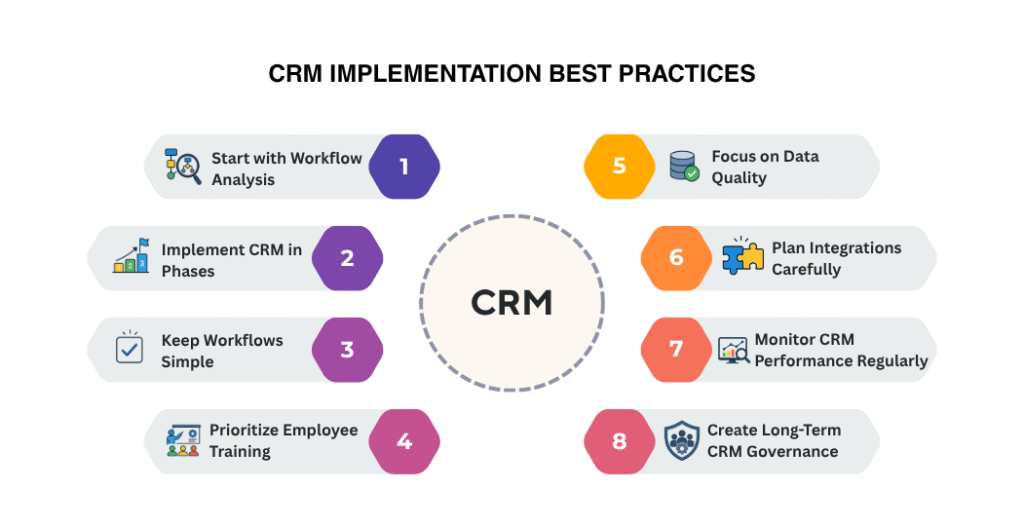
Businesses can reduce CRM implementation problems by following structured deployment strategies.
- Start with Workflow Analysis: Understand operational challenges before selecting CRM software.
- Implement CRM in Phases: Avoid deploying all features simultaneously.
- Keep Workflows Simple: Focus on usability and productivity instead of excessive customization.
- Prioritize Employee Training: Continuous training improves CRM adoption rates.
- Focus on Data Quality: Clean customer data before migration.
- Plan Integrations Carefully: Prioritize essential integrations first.
- Monitor CRM Performance Regularly: Track usage, reporting accuracy, and workflow efficiency.
- Create Long-Term CRM Governance: Assign ownership responsibilities and establish optimization processes.
How Codeflix Helps Businesses Overcome CRM Implementation Challenges
At Codeflix Global Technologies, CRM implementation is approached as a business transformation strategy rather than a software installation project.
We help organizations:
- Analyze operational workflows
- Design scalable CRM architectures
- Implement workflow automation
- Improve employee adoption
- Integrate CRM with business systems
- Optimize reporting and dashboards
- Streamline lead and support processes
Our CRM solutions are designed to improve operational efficiency, simplify customer management, and support long-term digital transformation goals.
Need Expert Support for CRM Implementation?
Implementing a CRM system without proper planning can lead to low adoption, workflow inefficiencies, data inconsistencies, and operational disruptions. Businesses need CRM solutions that align with real operational processes, employee workflows, and long-term growth strategies.
At Codeflix, we help businesses design and implement scalable CRM solutions tailored to sales operations, customer support workflows, automation requirements, and digital transformation goals.
From workflow analysis and CRM integration to employee onboarding and post-deployment optimization, our team ensures businesses achieve higher CRM adoption, improved operational visibility, and long-term ROI.
Whether you are planning a new CRM deployment or struggling with an existing system, our experts can help simplify implementation and improve business efficiency.
Conclusion
A CRM system should simplify operations, improve customer relationships, and support business growth — not create additional complexity for employees and management teams.
The most successful CRM implementations focus on aligning people, processes, and technology together. Businesses must approach CRM deployment as an ongoing operational strategy rather than a one-time technical project.
By understanding common CRM implementation challenges and following structured CRM implementation best practices, organizations can improve adoption, streamline workflows, and maximize long-term ROI.
As CRM platforms continue evolving with automation, AI, and predictive analytics capabilities, businesses that prioritize structured implementation strategies will gain a significant competitive advantage in customer engagement, operational efficiency, and long-term scalability.
FAQ
What are the biggest CRM implementation challenges?
Some of the biggest CRM implementation challenges include poor user adoption, data migration issues, integration complexity, workflow misalignment, and lack of employee training.
Why do CRM implementations fail?
CRM implementations usually fail because of poor planning, unclear business goals, weak change management, and low employee engagement during deployment.
What are common CRM integration challenges?
Common CRM integration challenges include API compatibility issues, delayed synchronization, disconnected systems, inconsistent reporting, and workflow interruptions.
How can businesses improve CRM adoption?
Businesses can improve CRM adoption through proper training, simplified workflows, employee involvement, and continuous support after deployment.
What are CRM implementation best practices?
CRM implementation best practices include workflow analysis, phased deployment, employee training, data validation, integration planning, and ongoing optimization.