
Codeflix

Introduction to Agentic AI vs Generative AI:

For the past decade, the term “AI” (Artificial Intelligence) has emerged as a popular topic; more recently, terms such as “generative AI” and “agentic AI” have gained traction. While traditional AI provides users with a new way to recognize patterns and analyze data, Gen AI can create new patterns and content, such as text, video, images, audio, or software code.
 
Apart from that, Agentic AI takes autonomous capabilities to another level by using a digital ecosystem of large language models (LLMs), Machine learning, and NLP to perform tasks on behalf of the user or another system. A gen AI model, which has gained more attention, is ChatGPT; this product provides similar creative abilities to Agent AI, but not the same ones.
 
Agentic AI focuses on decisions rather than just creating new content and doesn’t completely rely on human prompts nor require manual oversight. Early-stage Agentic AI examples include things like autonomous vehicles, virtual assistants, and copilots with task-oriented goals. Gen AI and Agent AI tools are offering various productivity benefits to both individuals and organizations. It is essential to differentiate between the two terms and how each functions to drive innovation and decision-making.

Key Differences Between Agentic AI and Generative AI

Before getting into the differences, first, we need to define both.
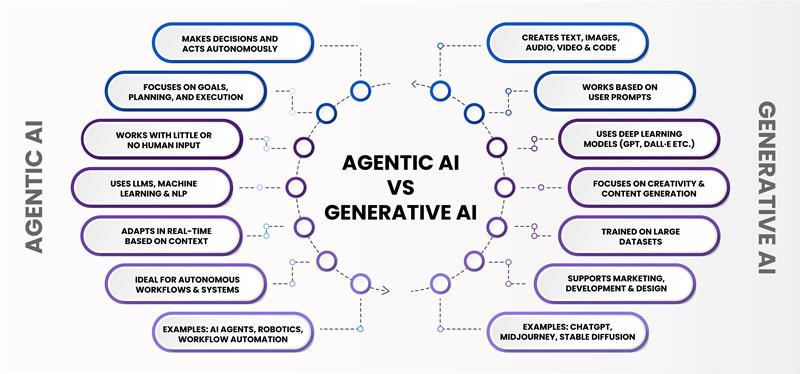
Agentic AI vs Generative AI
Generative AI is artificial intelligence that responds to user prompts or requests and creates original content, such as images, text, video, audio, or software code. Gen AI depends on using an ML model called Deep learning models, algorithms that simulate the learning and decision-making processes of the human brain, along with other technologies like Robotic Process Automation (RPA).
 
These models function by finding out and encoding the patterns and relationships in large amounts of data, and then using those details to understand users’ natural language requests or queries. and then these models can generate high-quality text, images, and other forms of content based on the data they were trained on in real-world scenarios.
 
Agentic AI is designed in a way that it makes decisions and acts with the ability to pursue complex goals without human intervention or with limited supervision. It brings together the LLM model’s flexible characteristics with the accuracy of traditional programming. In order to achieve the goal, this type of AI acts autonomously by using technologies like natural language processing (NLPs), machine learning, reinforcement learning, and knowledge representation.
 
This approach is a proactive AI-powered approach, whereas Gen AI is reactive to the user’s input. Agentic AI can adapt to different or various situations based on context; they have “agency” to make formal decisions. It is used in different applications that can help with independent operation, such as robotics, complex analysis, and virtual assistants.
 

Both Agentic AI and generative AI have objectives and distinct attributes that make them stand out from one another.

Key Features of Generative AI

Content Creation: 

It is one of the fields where GenAI excels. The AI models can create coherent context like essays and answers to difficult problems. With the help of user inputs, these AI Applications, like OpenAI’s ChatGPT, can generate answers, write lists, and give advice wherever needed. Gen AI solutions help developers with various skill levels to easily write code and support in the software development process.

Data Analysis: 

Generative AI can analyze a large amount of data and utilize that analysis to find patterns and trends. The gen AI models can streamline tough workflows, especially when it comes to the supply chain, and bring an enhanced customer experience.

Adaptability: 

Based on inputs from the users, Gen AI can adapt its outputs if the user is providing particular feedback to the model; the results shift to align more with what the user is seeking and, in turn, refine the output.

Personalization: 

Gen AI technology can offer personalized recommendations and experiences based on users’ inputs. For example, in the retail industry, it is possible to get highly personalized experiences for their customers, thanks to Gen AI technology that is helping them know everything about their customer preferences.

Key features of Agentic AI

Decision-Making: 

These AI systems have predefined plans and objectives that can assess the situations and determine the path forward without or with very minimal human input.

Problem Solving: 

Agentic AI uses a four-step approach for solving issues: perceive, reason, learn, and act. These four steps begin by having AI Agents gather and process data. Then comes LLM, which acts as an orchestrator that analyzes perceived data to understand the current situation. and it is integrated with external tools that are continuously improving and learning through feedback.

Autonomy: 

Agentic AI is defined by its Autonomous behavior. Its unique ability to learn and function on its own without any dependency is a promising technology for organizations seeking to streamline workflows and have instruments perform difficult tasks with minimal or no human input.

Interactivity: 

Because of its proactive nature, Agent AI can communicate with the outside environment and collect data to adjust in real time. We can describe this with an example of self-driving vehicles, which must constantly analyze their surroundings and make careful, proper driving decisions.

Planning: 

Agentic AI models can handle difficult scenarios and execute various steps strategies to achieve specific goals.

Agentic AI vs AI Agents: Understanding the Difference

It is necessary to differentiate between agentic AI and AI agents. Essentially, agentic AI is the framework; AI agents are the building blocks within the framework.
Agentic AI is the wider concept of fixing issues with limited guidance. whereas an AI agent is a specific feature within that system that is designed to handle tasks and processes with a degree of autonomy. This model is changing the way humans interact with AI. Agentic AI can easily understand the goal and vision of the user.  and uses the information that is given to solve a problem.
 
To describe this as an example, assume a smart home where agentic AI manages and runs the overall energy consumption system. This is accomplished by using real-time data and user preferences to coordinate individual AI agents like the smart thermostat, the lighting, or even appliances. These agents work together within the agentic AI framework to achieve the homeowner’s energy goals. and have individual goals and assignments.
 
There are various use cases available for generative AI; however, many applications of agentic AI are still in the development phase. Potential agentic AI use cases are emerging in functions like customer service, healthcare security, financial risk management and workflow management.

Use Cases of Generative AI

SEO Content Creation

Today, businesses use Gen AI to produce a large volume of SEO optimized content, such as blogs and landing pages, that help drive organic traffic. For eg digital marketing agency can use gen AI to produce high-quality, keyword-optimized blog posts or web pages for their clients to increase their brand awareness and rank higher on search results.

Marketing and sales

The Human Sales team is often restricted to administrative tasks, but their main motive is to find and develop sales leads. For a long time sales team has been a generative AI use case now through chatbots and virtual assistants. The AI technology can do specific tasks and drive optimization on a sales team, along with lead generation outreach.

Product design and development

The gen AI capabilities present can support organizations in creating new product concepts or designs based on market research, trends, and user preferences. which might speed up the product development cycle. The best example for this is a fashion company using Gen AI to design a new clothing line and generating designs based on consumer input and market data analysis.

Customer support automation

With the help of Gen AI, companies can automatically generate a response for customer service queries. The tools can craft answers for general questions and troubleshoot issues in real time. For example, take an e-commerce business. It can use Gen AI in chatbots to handle various tasks. such as order status inquiries, refund requests, and shipping questions.

Use Cases of Agentic AI

Customer service

The traditional models for customer chatbots had restrictions because of the pre-programmed nature of the technology, and would require human support at times. Whereas with autonomous agents, the models can easily understand what is actual customers’ intent and emotions. and take necessary steps to resolve the issue.
These autonomous systems can therefore predictively access a situation and help ensure a smoother customer interaction with a business. The customer experience is essential in today’s scenario as businesses seek out higher retention and enhanced loyalty. Specifically, agentic AI can automate tedious tasks by collecting, cleaning, and formatting an organization’s data. these systems can take responsibility for human employees and free them up to do more high-impact projects and tasks.

Healthcare

Already healthcare field uses AI technology in diagnostics, patient care, and streamlining administrative tasks. Cybersecurity is one of the vital features of any AI tool that is used in the healthcare space due to patient data and privacy concerns. This concern is carried forward into emerging agentic AI tools as well.
A suitable use case example for this comes from Propeller Health, which is integrating agentic AI into its smart inhaler technology. it is collecting current data from the patients on medication usage and outside factors like air quality. it automatically alert healthcare professionals whenever necessary and tracks patients’ health.

Automated workflow management

Agentic AI can take care of business processes autonomously and handle difficult tasks like reordering supplies and optimizing supply chain operations. it can regulate internal workflows, making it easier for human employees without any need for physical intervention.
For Instance, a logistics company that uses  an agentic AI system to automatically adjust delivery routes and schedules based on current traffic conditions and shipment priorities. Agentic AI is one of the good use cases for the logistics industry due to scalability and increased capacity.

Financial risk management

Agentic AI can support industries to meet their client goals and optimize the outcome in real time by analyzing market trends and financial data to make strong decisions about investments and credit risks. All the financial institutions want to protect their client’ investments, hence they are making smart and strategic decisions that result in higher returns.
Agentic AI can improve those practices further by acting autonomously and adjusting strategies based on real-time economic, social, and political events. For instance, a fintech company that uses agentic AI to monitor market uncertainty and automatically adjust portfolio allocations.

Agentic AI vs Generative AI: Current & Future Trends

Generative AI trends

Gen AI-Augmented Applications: 

There is a shift toward Gen AI-Augmented applications being associated with various software and platforms. This association is helping make the user experience even more personal and provide intelligent functions.

Synthetic data for model training: 
Synthetic data generated by AI will be helpful to train models where real-world data is unavailable or expensive. The use of synthetic data can be enhanced across various industries like robotics, autonomous driving, and finance.
Deepfake technology: 
It is one of the inventions of Gen AI, where it uses a hyper-realistic image or video by using AI that appears real. On the negative side, it has and is raising ethical concerns surrounding misinformation.

Agentic AI trends

Financial services industry: 
Agentic AI has the potential to revolutionize trading strategies by looking out the market data and expediting execution trades. The vast reach of Agentic AI is a huge benefit, as Agentic AI can be designed to search the web extensively. Agents are able to recover the updates and obtain real-time information.
Robotics: 
Amazon warehouses have already started to hire robots in fulfillment centers to streamline the warehouse automation and manufacturing processes. Agentic AI can manage difficult tasks and operate individually to perform specific tasks.
City Planning: 
Agentic AI systems in urban planning can analyze all types of datasets to support planners in making valid decisions, such as current-time traffic data and camera sensors. the intuitive nature of agentic AI has the potential to save teams hours of work to create PPT slides or tables.
Human Resources: 
In the human resources sector, Agent AI can help organizations go beyond gen AI capabilities and instead provide autonomous decision-making and dynamic employee support. AI Agents can regulate the usual work and provide personalized responses to employees, providing human resource professionals time to deal with more strategic priorities.

Conclusion: Agentic AI vs Generative AI in Modern Business

Both agentic AI and generative AI represent two major directions in artificial intelligence. GenAI is capable of unlocking creative and analytical potentials by generating fresh content at scale, while Agentic AI takes AI a step further through autonomous decision-making, contextual responses, and proactive behavior. Today, intelligent automation plays a vital role as most industries move towards it. Combining the creative strength of Gen AI with the operational independence of Agentic AI will support enterprises in delivering faster innovation, improved efficiency and smarter digital transformation.

Start Application

    Enquiry for:

    Eligible Candidates


    A bachelor's degree with an average of 50 percent or higher marks

    Basic understanding of mathematics and programming concepts

    Preferably, 2+ years of formal work experience

    This will close in 0 seconds

      Program Syllabus


      This will close in 0 seconds

        By providing your contact details, you agree to our Privacy Policy


        This will close in 0 seconds

          JobAssist Brochure


          This will close in 0 seconds

            Talk To An Admission Counselor

            By providing your contact details, you agree to our Privacy Policy


            This will close in 0 seconds

            Scroll to Top